
Use it with the field guides
See what each element of an equipment arc flash label tells you, why opening a panel changes the risk, and how an electrically safe work condition is created before work begins. Use the related field guides to keep safety labels distinct from asset labels and to identify the supplying circuit and every feed.
- Asset stickers and safety labels get mixed up
- The supplying circuit or disconnect is unclear
- A and B feeds are easy to confuse
Educational visualization with fictional label values. Real labels, boundaries, and PPE come from the facility's arc flash risk assessment under the adopted editions of NFPA 70E and the electrical code. Watching does not confer qualification or authorize work on or near energized equipment.
Chapters
Choose a chapter to read its transcript. Each time link opens that moment on YouTube.
- 0:00 The big picture
- 0:12 The PDU
- 0:37 The hazard
- 1:14 The label
- 1:52 De-energize
- 2:42 Controls
- 3:27 PPE
- 3:40 The whole picture
Full transcript
Read or save the Markdown transcript. Published .
The big picture
0:00 on YouTube ↗This is a floor-standing power distribution unit. Four hundred eighty volts comes in, a transformer steps it down, and two hundred eight volts goes out to every rack in the row. Today, one of its panels is open.
The PDU
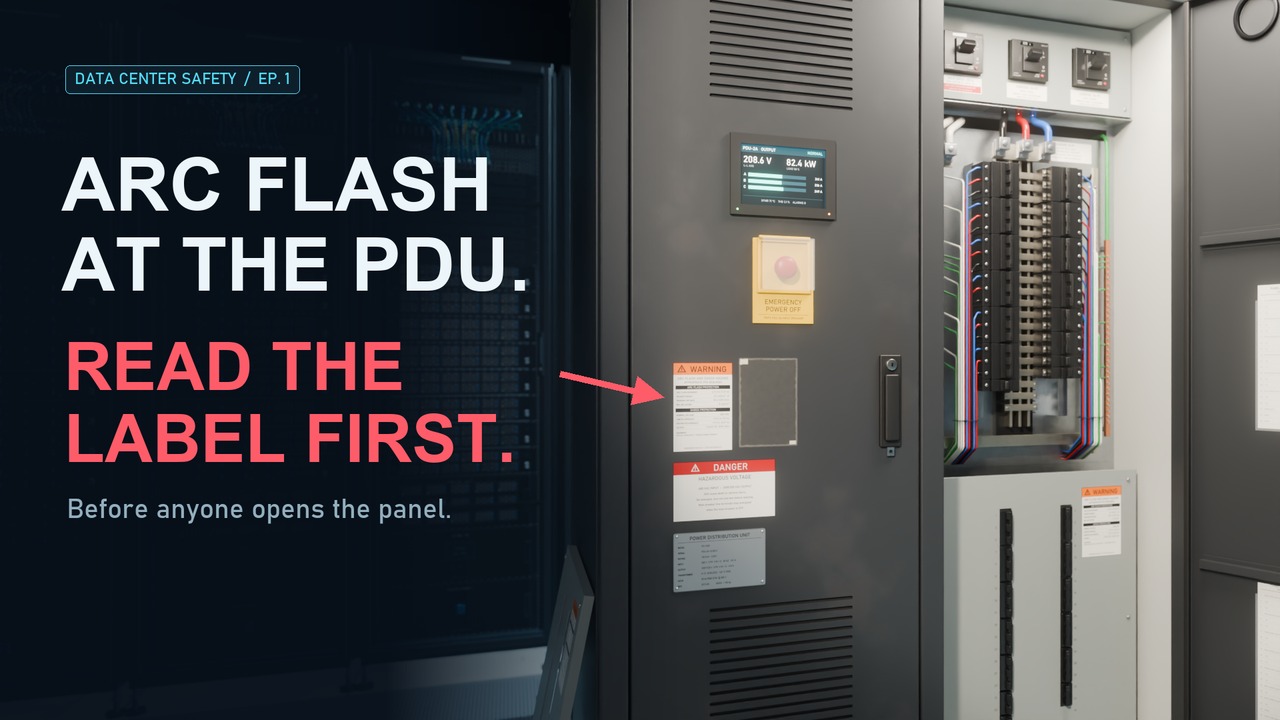
0:12 on YouTube ↗In a data hall, PDU can mean two very different things. A rack power strip is one. This is the other: a cabinet with its own transformer and panelboards that feed every rack circuit. Across the top sit the main input breaker and the subfeed breakers that protect each panelboard. Below them, two forty-two-circuit panelboards. On this one, the deadfront has been removed.
The hazard
0:37 on YouTube ↗An arc flash happens when current jumps through the air between conductors, or to ground. OSHA notes the arc itself can exceed thirty-five thousand degrees Fahrenheit, nearly four times the surface of the sun. An arc releases heat, intense light, a pressure release that can blow doors open and eject parts, and sound above a hundred thirty decibels. OSHA notes most arc flash burns come from clothing that ignites. With covers on and doors closed, properly installed and maintained equipment is unlikely to arc. Expose live parts, then add a dropped tool, a slipping probe or a loose connection, and the likelihood rises.
The label
1:14 on YouTube ↗This label tells you what you are dealing with: the nominal voltage, the arc flash boundary, the incident energy at a stated working distance, and the minimum arc rating of clothing. The NEC adds the assessment date. The arc flash boundary is where incident energy falls to one point two calories per square centimeter: the onset of a second-degree burn on bare skin. Cross it, and arc-rated protection is required. Shock has separate boundaries. For both the two-hundred-eight and four-hundred-eighty volt parts of this unit, the limited approach is three feet six inches from fixed live parts, and restricted approach is one foot.
De-energize
1:52 on YouTube ↗The safest arc flash is the one that cannot happen. Start by finding every source. This unit is fed from UPS-2A, breaker 2A-04. The label and the drawings must agree. Opening this main breaker de-energizes the transformer and both panels, but not the breaker's own line terminals. They stay live until the upstream breaker is opened and locked. To create an electrically safe work condition, interrupt the load, open the disconnecting devices, verify they are actually open, release any stored energy, and apply locks and tags under a written procedure. Then test for absence of voltage at each point of work, phase to phase and phase to ground, with a tester you prove on a known live source before and after. Untested means energized.
Controls
2:42 on YouTube ↗NFPA 70E ranks risk controls. Elimination comes first. Then substitution, engineering controls, awareness, administrative controls, and personal protective equipment last. Each is less effective than the one before. Energized work needs a justification, such as a greater hazard or real infeasibility, and an energized work permit. Neither NFPA 70E nor OSHA lists convenience or uptime. The 2027 edition adds a trained standby person. Engineering controls help. An infrared window lets thermography happen with the door closed, a task NFPA 70E rates as unlikely to cause an arc flash when done outside the restricted approach boundary.
PPE
3:27 on YouTube ↗When exposure can't be eliminated: arc-rated clothing rated at or above the incident energy, an arc-rated hood or face shield, hearing protection, rubber insulating gloves with protectors, and leather footwear.
The whole picture
3:40 on YouTube ↗Know the source. Read the label. Respect the boundaries. De-energize, lock and test. And treat protective equipment as the last line of defense, never the first.
Primary references
These references support the hazard description, the label elements, electrically safe work practices, and the edition notes. The video paraphrases them and shows NFPA 70E-2024 section numbers; it does not restate requirement text or assert a compliance outcome.
- OSHA: Electric-arc flash hazards ↗
How arc flash occurs and the heat, light, pressure, and sound it can release. The temperature figure in the video is quoted from OSHA's description.
- OSHA 4472: Protecting employees from electric-arc flash hazards ↗
OSHA's fact sheet on arc flash hazards, de-energizing equipment, and protective equipment for exposed employees.
- 29 CFR 1910.333: Selection and use of work practices ↗
Federal electrical safety-related work practices for deenergizing parts, lockout and tagging, and verifying the absence of voltage.
- NFPA 70E revision records (2024 and 2027 editions) ↗
Committee records for the 2027 revision of NFPA 70E. Section numbers shown on screen come from the 2024 edition; the adopted edition governs.
- NFPA 70 (NEC) 110.16 arc flash marking revision records ↗
Committee records for the 2026 NEC arc flash marking provisions, including the assessment date the video mentions. The adopted code edition governs installed marking.
Original Blender 3D animation built from user-owned models of a floor PDU, lockout/tagout kit, arc-rated PPE ensemble, and raised floor, with AI-assisted scripting, synthetic English narration, and original synthesized music. Equipment and labels are generic; no manufacturer endorsement is implied.