
Use it with the field guides
Connect each device to its physical function. This episode helps safety teams distinguish a permanent equipment identifier, an energy-control tag, and the hardware that holds an isolating device in position.
- Asset stickers and safety labels get mixed up
- Identify cooling valves and isolation points
- The supplying circuit or disconnect is unclear
Educational examples for safety professionals. Actual work requires trained personnel, the employer’s equipment-specific energy-control procedures, and the manufacturer’s instructions. Watching does not confer authorization or electrical qualification.
Chapters
Jump to a transcript section; its time link opens that moment on YouTube.
- 0:00 The hardware has a specific job
- 0:47 Safety padlock: personal control
- 1:36 Tag: communicate the restriction
- 2:21 Breaker clamp: secure the correct operator
- 3:06 Hasp: several people, one locking point
- 3:52 Valve device: prevent the required movement
- 4:37 Cable lockout: restrain without leaving slack
- 5:20 Plug enclosure: prevent reconnection
- 6:03 Group lockbox: secure the isolation keys
- 6:48 The selection check before the job
Full transcript
Read or save the Markdown transcript. Published October 2, 2026. Original 3D animation, AI-assisted scripting, and synthetic English narration.
The hardware has a specific job
0:00 on YouTube ↗A lockout kit contains several mechanisms because isolation points are not all shaped the same way. A breaker toggle, a valve handwheel, and an electrical plug each need a different way to prevent operation or reconnection. Start with the equipment-specific procedure and the actual isolating device. Then select compatible hardware. A device that happens to fit loosely is not an acceptable substitute for a secure installation. In this episode, the models show operating principles. They are not installation instructions for a particular product. Check the manufacturer's compatibility, application, environmental, and inspection requirements before using real hardware.
Safety padlock: personal control
0:47 on YouTube ↗The safety padlock is the personal control point in many lockout systems. Its closed shackle prevents the compatible device from being released. The employee must be identifiable, and the lock belongs to the energy-control program rather than serving as a general-purpose storage lock. The body material and shackle design depend on the application. Color conventions also belong to the facility; OSHA does not prescribe one universal personal-lock color for every workplace. In our animation, follow the shackle as it closes. In use, it must capture the compatible locking point. The important feature is positive retention of the mechanism, together with the program's identification and key-control arrangements.
Tag: communicate the restriction
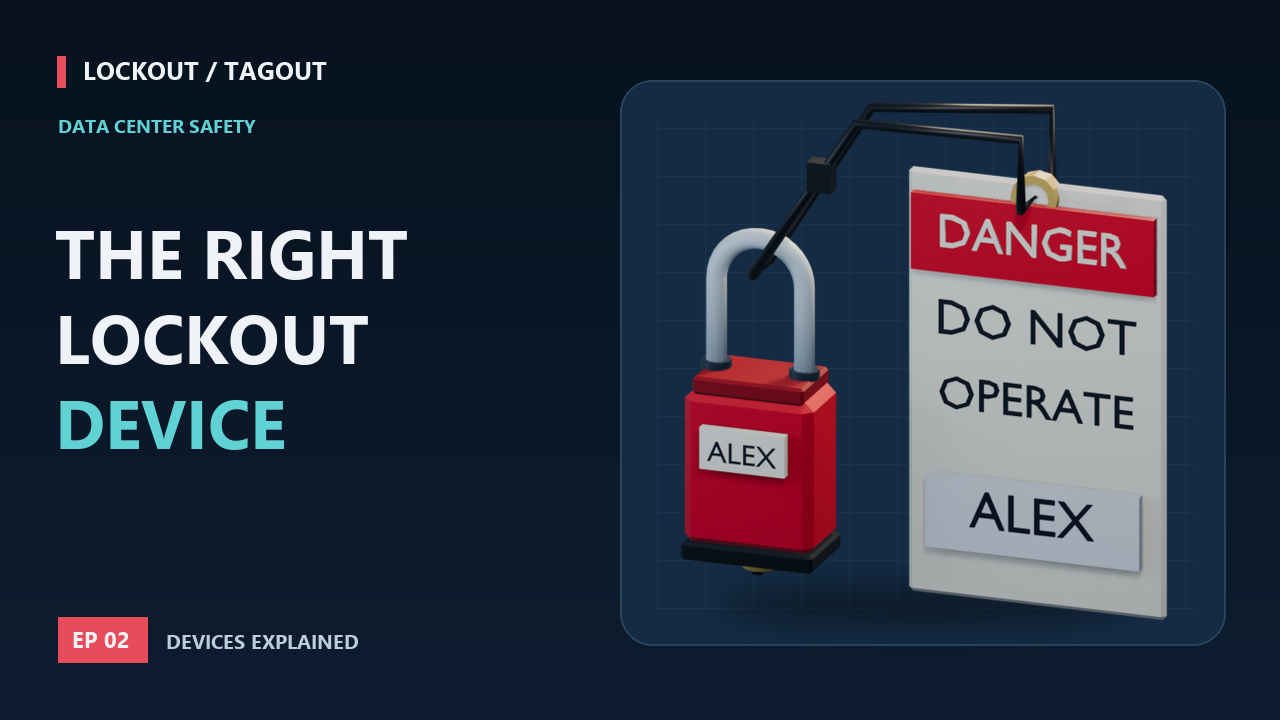
1:36 on YouTube ↗A tag communicates information that a padlock alone cannot. It identifies the person and warns against operating the isolated equipment. The employer's system may add the job reference, equipment identifier, date, and contact information. Keep the tag legible and attached by the approved means. In the close-up, notice the tag's separate attachment to the secured shackle: it communicates the restriction, but it does not provide the physical restraint. Tagout is not a casual substitute when someone has forgotten a lock. Using a tagout system instead of lockout is subject to specific protection requirements under the applicable standard and the employer's program.
Breaker clamp: secure the correct operator
2:21 on YouTube ↗Breaker lockout devices use mechanisms such as a clamp, pin, or purpose-designed attachment to secure a compatible operator. This model illustrates a clamp-type principle. The jaw engages the operator; the adjustment establishes the required fit; the locking feature is closed; and the padlock prevents release. Real products differ, so the order and adjustment come from the device instructions. Fit and retention must be checked without defeating the isolation. A correctly installed clamp on the wrong breaker still protects the wrong circuit. And locking a branch breaker does not establish that the panel's bus, incoming terminals, or neighboring circuits are deenergized.
Hasp: several people, one locking point
3:06 on YouTube ↗A lockout hasp provides several personal-lock positions at one compatible locking point. Its jaw passes through the point that must remain secured. Each participating authorized employee applies a personal device under the procedure. The geometry matters: the closed padlocks prevent the hasp from opening and releasing the isolation mechanism. Do not exceed the hasp's capacity or improvise an arrangement that lets it disengage. For a small job, a hasp can make individual control easy to see. For many isolation points and a larger crew, a group lockbox can simplify the arrangement. We will follow that complete key-control chain in episode three.
Valve device: prevent the required movement
3:52 on YouTube ↗Valve lockout hardware must match the valve mechanism. Some covers enclose a handwheel so it cannot be operated. Other devices restrain a lever against a compatible stop or pipe arrangement. Our example shows a lever restrained in the procedure's isolation position. The lock prevents release of that restraint. Do not assume every valve closes in the same direction or that the handle alone proves internal valve position. More fundamentally, stopping the handle does not remove trapped pressure from the section being serviced. The procedure must separately address draining, venting, blocking, or other appropriate stored-energy controls and verification.
Cable lockout: restrain without leaving slack
4:37 on YouTube ↗An adjustable cable device can secure suitable mechanisms that are difficult to reach with a rigid device. The cable follows the manufacturer's permitted route through the securing points. Its adjustment removes the slack that would otherwise allow operation, and the padlock prevents release. Watch the loose loop tighten in the illustration. A cable draped around a handle may look convincing while still allowing the handle to travel. Cable material, routing, bend limits, and electrical suitability depend on the product and application. Treat it as an engineered device with compatibility limits, not a universal solution for every valve or breaker.
Plug enclosure: prevent reconnection
5:20 on YouTube ↗A plug enclosure captures a disconnected plug and prevents it from being reconnected while the enclosure is locked. Select an enclosure that actually contains the plug and closes as designed around the cable. In a dual-supply system, securing one plug says nothing about the other supply. There is also a limited OSHA exception for certain cord-and-plug equipment when unplugging controls the relevant hazard and the plug remains under the servicing employee's exclusive control. That exception is not a blanket exemption for server work or all equipment in the room. Confirm its applicability through the employer's program, including any remaining energy sources.
Group lockbox: secure the isolation keys
6:03 on YouTube ↗The group lockbox does not interrupt electricity or close a valve. Its job is to protect access to the keys for the locks securing the isolation points. Each participating authorized employee places a personal lock on the box or approved group mechanism. The approved arrangement prevents the isolation keys from being accessed while personal protection remains in place. Our clear cutaway makes this relationship visible: isolation point, isolation lock, key, lockbox, personal lock. If a key outside that chain can routinely defeat the protection, the mere presence of a locked box is not enough. The complete group procedure must preserve each worker's control.
The selection check before the job
6:48 on YouTube ↗Before maintenance begins, challenge the installation at three levels. Is this the correct isolation point for the work? Does the selected hardware positively secure it as designed? Has the complete energy-control procedure established and verified the required condition? A tidy row of red devices answers none of those questions by itself. Worn, damaged, incompatible, or incomplete hardware needs to be replaced with an appropriate device, not forced into service. The best demonstration is one in which the viewer can trace exactly what movement the hardware prevents. Next, we add several people and several isolation points, and see why group coordination matters as much as the box.
Episode reference links
These are the primary references used in the episode. Manufacturer documents apply to the equipment they describe; the animation is conceptual. Check the actual installation, applicable requirements, and current equipment instructions before planning work.
- OSHA eTool - Materials and hardware ↗
- OSHA Lockout-Tagout eTool - Definitions ↗
- OSHA 29 CFR 1910.147 - The control of hazardous energy ↗
- Master Lock 506 - Clamp-style breaker lockout mechanism ↗
- OSHA 29 CFR 1910.333 - Selection and use of work practices ↗
- OSHA eTool - Group lockout/tagout procedures ↗
- Master Lock Safety Series instruction booklet ↗
- OSHA eTool - Specific procedures and control-circuitry prohibition ↗
- Master Lock S806 cable-lockout product sheet ↗
- OSHA cord-and-plug maintenance interpretation, April 3, 2012 ↗
- Master Lock 498A - Group lockbox operating principle ↗
- OSHA eTool - Required content of energy-control procedures ↗