
The practical answer
Name the facility-side and technology-side loops as separate controlled references and record which distribution unit sits between them. List the served racks as identities rather than a row description, and cite the schematic revision that supports the assignment. A register can establish the documented assignment; it does not establish that a unit has capacity for its served set.
The method, examples, and sources below explain the scope and checks.
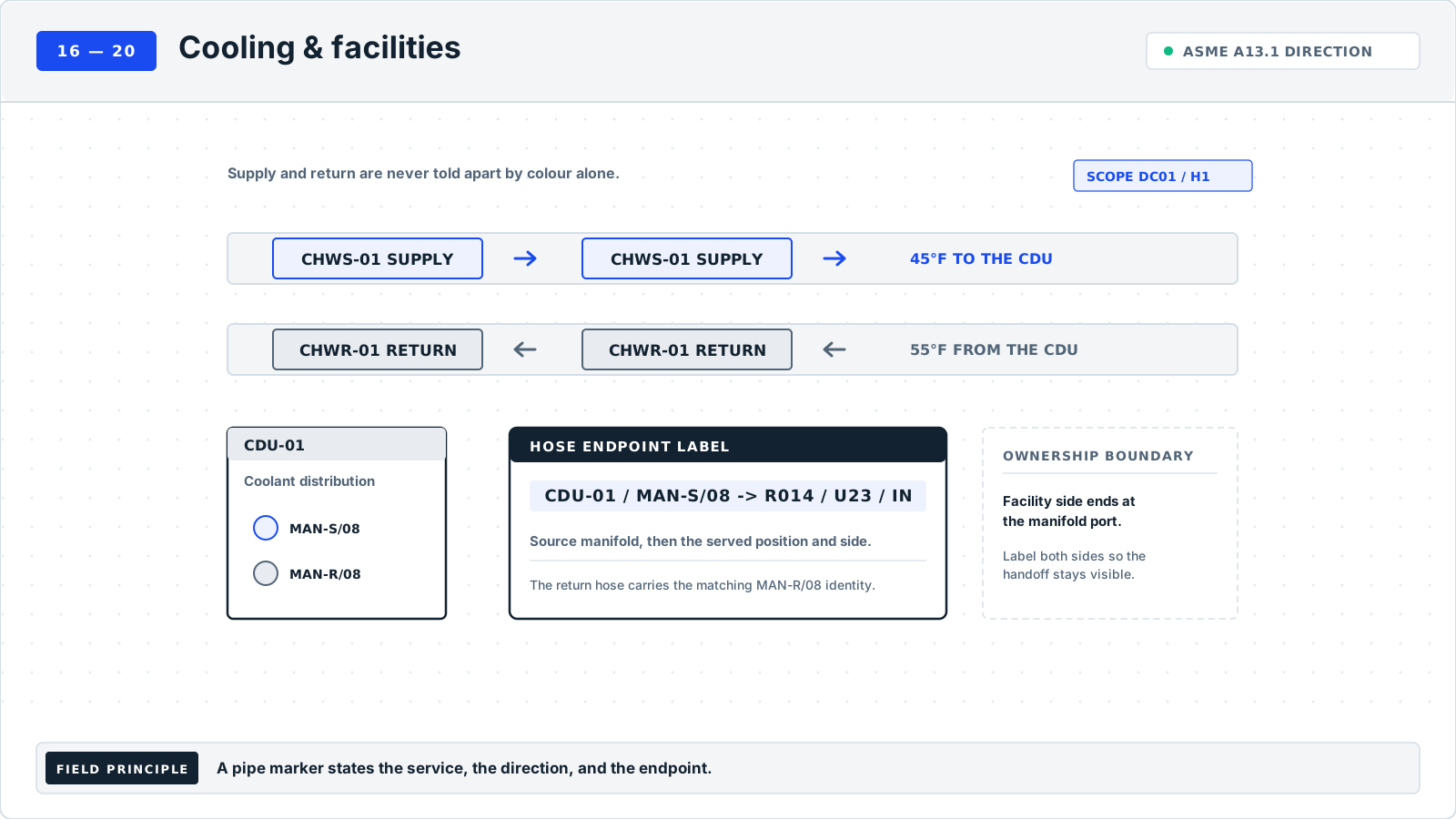
Examples are fictional local conventions. Unless another location is shown, the scope is DC01 / H1. Keep that scope with shortened identifiers.
When to use#
Use this guide when a rack, manifold, or unit label names a cooling loop that cannot be resolved to one distribution unit and one served set. The output is a loop and unit service register. Guide 16 identifies a pipe segment and guide 17 identifies an individual hose; this page records the level above both, where a loop is named and a unit is assigned the racks it serves.
What to gather#
Gather the mechanical schematic and its revision, the distribution unit asset records, the loop names in use on labels and in the monitoring system, the manifold identities, and the list of racks or enclosures each unit is recorded as serving.
ASHRAE publishes the Datacom series, where data centre design conditions are defined. A design envelope describes conditions for a space; it does not name a site's loops or assign racks to a unit. ASHRAE source
Identification workflow#
These steps are this library's recommended recordkeeping method.
- Name the two sides separately. Record the facility-side loop and the technology-side loop as distinct references, even where a site's habit is to call both by one name. A single name across a heat exchanger hides the boundary that matters most.
- Fix the unit identity. Record the distribution unit's controlled asset identity alongside any monitoring alias and any label text observed on the unit. These are three references that often disagree.
- Record the served set explicitly. List the racks, manifolds, or enclosures the record assigns to this unit, rather than a row description or a count. State whether the list is complete against the schematic or only against observation.
- Record uncertainty precisely. Flag an unresolvable loop name, a unit with no controlled asset record, and a served rack that appears under two units as separate findings. Refer each to the mechanical owner; this survey changes no valve position or control setting.
- Link redundancy to its documented basis. Where units share a loop or stand by for one another, record the reference that establishes the arrangement rather than inferring it from adjacent numbering.
The expanded procedures and fictional case below are original editorial recordkeeping guidance to adapt to the site's approved process.
Decide which level of the cooling topology is uncertain#
Start by separating three things that a single loop label tends to merge: the loop as a named circuit, the unit that conditions and circulates it, and the set of racks it reaches. A loop name may be perfectly stable while two units both claim to serve it. A unit may have a clean asset record while the racks assigned to it were last updated before a row was added. A rack label may name a loop that exists only in the monitoring system and not on the schematic. Each is a different finding, and none is resolved by adopting whichever name appears most often.
If the schematic revision is uncertain, resolve it before accepting any unit-to-rack assignment built on it. If the schematic is established but a unit carries no controlled asset identity, keep the unit unconfirmed and record what is needed to establish it, rather than promoting a monitoring alias into the asset record. If one rack appears under two units, preserve both claims with their sources instead of deleting the one that looks less likely. A register row can otherwise read as complete while the loop, the unit, and the served set have never been checked against one another.
Define the included scope before starting. A survey may cover one hall, one deployment package, or the units supporting a single row of high-density racks. Record the full site and hall scope and identify any unit or served rack outside the inspected area that still appears in a claim. Keep this task distinct from the pipe survey in guide 16 and the hose register in guide 17. Those describe a segment and an assembly; this register describes which circuit exists, which machine drives it, and what it reaches.
Separate the primary and secondary loops in the record#
The most useful thing this register does is refuse to let one name cover both sides of a heat exchanger. Record the facility-side loop reference and the technology-side loop reference in their own fields, and record the unit that sits between them. Where a site uses a single colloquial name for both, preserve that name as an observed alias and keep the two controlled references separate underneath it. A responder who is told only that a rack is on "loop 2" cannot tell whether a facility-side event or a technology-side event is the one affecting it.
Keep the loop's identity separate from the unit's identity. A loop can outlive the unit serving it, and a unit can be re-assigned to a different loop after a change. Recording them in one merged field makes the row unusable in exactly the situations that matter: a unit swap that keeps the loop, or a re-piping that keeps the unit but moves it to another circuit. Preserving both relationships lets the register answer the two questions people bring to it under pressure, which are what does this unit affect and what is behind this rack's loop label.
Record observation limits plainly. If a loop reference was read from a monitoring screen rather than a label or schematic, say so in the evidence field. If a unit's nameplate is obscured, record the visible portion and cite the asset record separately rather than reconstructing the identity. Marker placement on the pipework itself follows the pipe identification in guide 16 and the site's accepted method, keeping existing information readable. The examples here show identity content only; they are not a piping specification, a capacity statement, or permission to change a control setting.
Record the served set rather than a summary#
Served scope is the field most often written as a summary and most often wrong. "Row 4" is a description; RCK-G32-401 through RCK-G32-408 is a set, and a set can be compared against the schematic. Where a unit serves manifolds rather than racks directly, record the manifold identities and let guide 17's hose register carry the connection detail below them. State whether the set was established from the schematic, from observation, or from both, because a set confirmed only by walking the aisle will miss a rack fed from an adjacent hall.
Keep the service claim distinct from any statement about capacity or performance. A register can establish that the schematic assigns these racks to this unit at this revision. It cannot establish that the unit has the capacity to serve them under any particular load, that flow reaches every manifold, or that a failover arrangement will function. Those belong to the mechanical owner's design and commissioning records. Where a change package requires the affected racks to be identified before work, the register supplies that identification; it does not approve the work or predict its thermal effect.
Record redundancy as a documented relationship, not an inference. If two units are recorded as serving the same set in an N+1 arrangement, name the reference that establishes it and state whether the arrangement is concurrent or standby. Adjacent asset numbers and matching model names are not evidence of a redundant pair. Where the arrangement cannot be established from records, keep it unresolved and say so, because an assumed redundancy is more damaging in an incident than an acknowledged gap.
Worked case: two units named the same loop#
In this fictional DC01 / H1 case, rack labels in one row name secondary loop TCS-G32-002. Distribution unit CDU-G32-301 is recorded in the asset system as serving that loop, while the monitoring system shows unit CDU-G32-302 reporting under the alias "Loop 2" as well. Survey LCASE-G32-301 records the rack label text, both unit identities, and schematic MECH-G32-340 revision 4 as separate values. The first finding is an alias collision between a controlled loop reference and a monitoring display name, not a duplicated loop.
The mechanical owner reviews the schematic against the monitoring configuration. In fictional decision DEC-G32-002, the owner confirms that TCS-G32-002 is served by CDU-G32-301, and that CDU-G32-302 serves TCS-G32-003, whose display name was configured as "Loop 2" during an earlier commissioning step and never corrected. The accepted record keeps both controlled loop references, records the monitoring alias against CDU-G32-302 as a known display discrepancy, and raises the correction through the monitoring owner rather than relabelling any rack.
Closeout records the reconciled assignments under EV-G32-311, links DEC-G32-002 and the monitoring change reference, and reviews the rack labels in both rows for the same alias. Four racks in the second row are found to carry the display name rather than the controlled reference and are listed for correction through the accepted process. The completed case states which loop and unit assignments were reconciled to which schematic revision. It does not assert that either unit has capacity for its set, and it does not establish a failover relationship between them.
Variations to keep visible in the register#
Some sites operate a shared secondary loop across several units, where no single unit owns the served set. Record the loop's served set at the loop level and each unit's contribution as its own relationship, rather than duplicating the full rack list under every unit. Duplicated sets drift apart at the first change, and the register then holds several confident and disagreeing answers to the same question.
A unit replacement can preserve the loop and the served set while changing the asset identity, the model, and the monitoring alias all at once. Keep the loop reference stable through that event and record the unit change as its own history entry with an effective reference. Without that separation an investigation covering the earlier period will attribute behaviour to a unit that was not installed at the time.
Where a rack is fed from a manifold shared between two loops, or is recorded against a loop in one system and a unit in another, keep each claim with its source system rather than choosing a winner in the worksheet. The register's value in that situation is that it shows the disagreement precisely enough for the mechanical owner to resolve it. A row that silently adopts one system's answer removes the only evidence that a reconciliation was ever needed.
Failure patterns and closeout evidence#
Look for one name used on both sides of a heat exchanger, monitoring display names promoted into controlled references, served sets written as row descriptions, and redundancy inferred from adjacent numbering. A further recurring failure is a served set that was correct at commissioning and never revisited after racks were added, which reads as authoritative and is invisible without a schematic comparison. Review the units named in a deployment package together rather than one at a time. A useful closeout names the loop, the unit, the served set, the schematic revision, and the change event that made the assignment current.
Final evidence should distinguish what was observed from what was accepted through records. Keep the original conflicting values, the mechanical owner's decision, and the final comparison together. Record any served rack established only from a monitoring view and name the follow-up needed to confirm it against the schematic. Enter the actual review date for the supported scope only. A commissioning completion notice does not establish that every loop name and served set in the register was reviewed.
Worked example#
Example only: invented loop, unit, and rack names.
SCOPE: DC01 / H1
UNIT CDU-01      LABEL READS: LOOP 2
Facility loop    FWS-01
Technology loop  TCS-02
Serves           RCK-401 .. RCK-408 (8 racks)
Schematic        Example MECH-340 rev 4
TCS-02 and CDU-01 are fictional designations, not an ASHRAE classification or a capacity claim.
Common mistakes#
- Using one loop name on both sides of the heat exchanger.
- Copying a monitoring display name into the controlled record.
- Recording a served set as a row description instead of rack IDs.
- Inferring an N+1 pair from adjacent asset numbers.
Verification#
Worksheet: Cooling loop and unit service register#
| Field | Definition |
|---|---|
| Unit ID | Controlled asset identity of the distribution unit. |
| Observed label | Unit label text preserved exactly as observed. |
| Monitoring alias | Display name in the monitoring system, kept separate. |
| Facility loop | Facility-side loop reference serving the unit. |
| Technology loop | Technology-side loop reference distributed by the unit. |
| Serves | Racks, manifolds, or enclosures in the served set. |
| Set basis | Whether the set came from the schematic, observation, or both. |
| Redundancy | Documented arrangement and the reference establishing it. |
| Schematic | Controlling schematic and revision. |
| Status | Identity-review state or unresolved detail. |
| Evidence | Observation and record references supporting the row. |
| Owner | Team responsible for the mechanical system. |
| Verification date | Actual date the assignment is reviewed. |
Filled example row - fictional; no live verification.
| Unit ID | Observed label | Monitoring alias | Facility loop | Technology loop | Serves | Set basis | Redundancy | Schematic | Status | Evidence | Owner | Verification date |
|---|---|---|---|---|---|---|---|---|---|---|---|---|
| CDU-01 | LOOP 2 | Loop 2 | FWS-01 | TCS-02 | RCK-401 .. RCK-408 | Schematic and observation | Not established in records | Example MECH-340 rev 4 | Alias collision pending review | Fictional EX-32; schematic r4 | Example mechanical owner | Not verified (fictional) |
FAQs#
Why record the facility loop and technology loop separately?#
Because they fail separately and are owned separately. One name spanning both sides of a heat exchanger cannot tell a responder which side an event is on. Keeping two controlled references, with any shared colloquial name preserved as an alias, makes that distinction available when it is needed.
Can the monitoring system's loop name be the record?#
Keep it as an alias unless the mechanical owner establishes it as the controlled reference. Display names are configured during commissioning and are often edited later without a change record, so promoting one into the asset system moves an uncontrolled value into a controlled field.
Should the served set list every rack individually?#
List identities rather than a description, because a set can be compared against the schematic and a description cannot. Where a unit serves manifolds, list the manifold identities and let the hose register in guide 17 carry the connection detail beneath them.
How should an N+1 arrangement be recorded?#
Record the documented arrangement and cite the reference that establishes it, and state whether it is concurrent or standby. If no record establishes the relationship, leave it unresolved rather than inferring it. An assumed redundancy is more damaging during an incident than a gap that everyone can see.
What if one rack appears under two units?#
Keep both claims with their source systems and refer the conflict to the mechanical owner. The register's purpose in that case is to show the disagreement precisely. Deleting the less likely claim removes the evidence that a reconciliation was needed and tends to reproduce the same conflict later.
Does this register establish that a unit can cool its served set?#
No. It records which racks the schematic assigns to which unit at a stated revision. Capacity, flow distribution, and failover behaviour are established by the mechanical owner's design and commissioning records, and a label or record review cannot substitute for them.
More worked label examples
Two additional ways to apply this guide. Keep the exact identifiers and relationships consistent with your own approved records.
GUIDE 32 / EXAMPLE 1
Name both sides of the heat exchanger on one unit
The unit label carries a short working name while the register keeps the facility-side and technology-side references separate, because the two sides fail and are owned separately.
SCOPE: DC01 / H1; unit CDU-G32-101
SCHEMATIC: MECH-G32-101 r2

FACILITY SIDE      UNIT           TECHNOLOGY SIDE
FWS-G32-101  ---> [ CDU-G32-101 ] ---> TCS-G32-101
                                        |
                        RCK-G32-101 .. RCK-G32-106 (6)

UNIT LABEL FACE
+------------------------------+
| CDU-G32-101                  |
| FWS-G32-101 / TCS-G32-101    |
+------------------------------+
Set basis: schematic and observation- A responder told only that a rack is on "loop 2" cannot tell which side of the heat exchanger an event is on. Two controlled references make that distinction available; any shared colloquial name stays an alias.
- FWS-G32-101 and TCS-G32-101 are fictional references. The served set lists rack identities rather than a row description so it can be compared against the schematic revision recorded with it.
GUIDE 32 / EXAMPLE 2
Separate a monitoring display name from the controlled reference
Two units appear to serve one loop because a display name configured at commissioning was never corrected, so the finding is an alias collision rather than a duplicated loop.
SCOPE: DC01 / H1; survey LCASE-G32-201
SCHEMATIC: MECH-G32-201 r4

OBSERVED
CDU-G32-201  asset -> TCS-G32-201   monitoring -> "Loop 2"
CDU-G32-202  asset -> TCS-G32-202   monitoring -> "Loop 2"
Rack labels in row 4 read: LOOP 2

ACCEPTED UNDER DEC-G32-201
CDU-G32-201 -> TCS-G32-201 (controlled)
CDU-G32-202 -> TCS-G32-202 (controlled)
"Loop 2" -> alias on CDU-G32-202, raised to monitoring owner
Rack labels carrying the alias: listed for correction- Keep the display name as an alias unless the mechanical owner establishes it as the controlled reference. Display names are edited after commissioning without a change record, so promoting one moves an uncontrolled value into a controlled field.
- Correct the monitoring configuration through its own owner rather than relabelling racks to match it. The register records which assignments were reconciled to revision r4; it makes no capacity or failover claim.
Sources and applicability
- ASHRAE: Datacom series and data centre resources ↗
Publisher page for the material where data centre design conditions are defined. A room design envelope is not a measurement at a label position. Checked September 12, 2026.
Read scope and linked guides - ASME: A13.1 piping identification ↗
Public scope overview only; no complete color or placement specification was accessed.
Read scope and linked guides