
Use it with your own records.
- Download the workbook and open 32 Cooling loops.
- Enter your site and room scope and the project or policy reference.
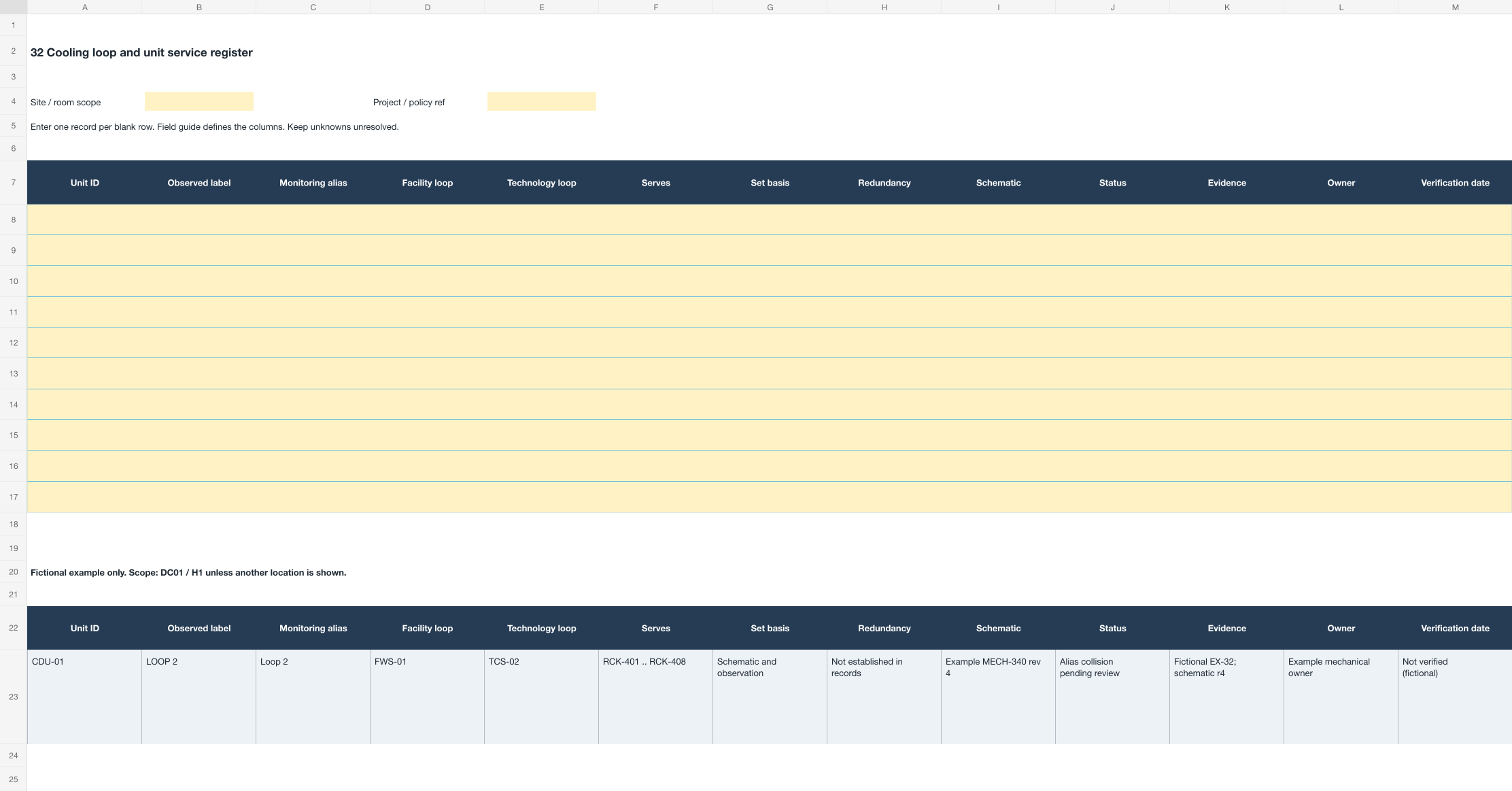
- Use the blank amber table for actual records. The fictional example below it is a reference.
- Insert table rows when needed. Keep identifiers as text, including leading zeros.
- Follow guide 32 to complete the checks and record unresolved items.
Before you start
- Define the included units and the full location scope, separating the loop as a named circuit from the unit that serves it and the racks it reaches.
- Collect the mechanical schematic and its revision, the distribution unit asset records, the monitoring configuration, and any deployment package affecting the served sets.
- Confirm how local policy distinguishes a controlled loop reference, a monitoring display name, and a unit asset identity.
- Establish whether each served set will be taken from the schematic, from observation, or from both, and record that basis before completing rows.
Complete the register
- Enter the Unit ID as the controlled asset identity, keeping any monitoring alias and observed label text in their own fields.
- Record the facility-side and technology-side loop references separately, preserving a shared colloquial name as an alias rather than a controlled value.
- Enter Serves as a list of rack, manifold, or enclosure identities, and record whether the set is complete against the schematic.
- Record Set basis explicitly so a set confirmed only by walking the aisle is distinguishable from one checked against the drawing.
- Record Redundancy only where a document establishes it, naming that reference and stating whether the arrangement is concurrent or standby.
- Preserve conflicting claims from different source systems with their sources instead of choosing a winner in the worksheet.
- Attach evidence for each row and link the owner decision and any monitoring change reference raised by the review.
Walk through the example
For the fictional LCASE-G32-301 survey in DC01 / H1, record the rack label text naming TCS-G32-002, the asset record for CDU-G32-301, and the monitoring alias shown against CDU-G32-302 as separate values, with schematic MECH-G32-340 revision 4 cited for all of them. The first finding is an alias collision, not a duplicated loop. DEC-G32-002 establishes that TCS-G32-002 is served by CDU-G32-301 and that CDU-G32-302 serves TCS-G32-003, whose display name was configured during commissioning and never corrected. Keep both controlled loop references, record the alias against CDU-G32-302 as a known display discrepancy, and raise the correction with the monitoring owner rather than relabelling racks. Link EV-G32-311 and review the rack labels in both rows, listing the four found carrying the display name. Record the actual review date. The completed row explains which assignment was reconciled to which revision; it does not assert capacity or establish a failover relationship.
Handle common exceptions
One rack appears under two different units.
Keep both claims with their source systems and refer the conflict to the mechanical owner. Deleting the less likely claim removes the evidence that a reconciliation was needed.
A secondary loop is shared across several units with no single owner.
Record the served set at the loop level and each unit’s contribution as its own relationship, rather than duplicating the full rack list under every unit.
A unit was replaced while the loop and served set stayed the same.
Keep the loop reference stable and record the unit change as its own history entry with an effective reference, including the new asset identity, model, and alias.
Review and close
- Confirm no single name is used on both sides of the heat exchanger and that both loop references are controlled values.
- Check that every served set lists identities and carries its basis, and that sets were compared against the recorded schematic revision.
- Keep unit-replacement history retrievable so behaviour in an earlier period is not attributed to a later unit.
- Review the racks in an affected row for labels carrying a monitoring display name rather than the controlled reference, and list them for correction.
- Record the actual verification date and retain unresolved redundancy or capacity questions separately from any commissioning acceptance.
Fields and filled example
Fictional values only. Scope: DC01 / H1 unless another location is shown. The downloadable register is blank for your actual observations.
| Field | What to record | Fictional example |
|---|---|---|
| Unit ID | Controlled asset identity of the distribution unit. | CDU-01 |
| Observed label | Unit label text preserved exactly as observed. | LOOP 2 |
| Monitoring alias | Display name in the monitoring system, kept separate. | Loop 2 |
| Facility loop | Facility-side loop reference serving the unit. | FWS-01 |
| Technology loop | Technology-side loop reference distributed by the unit. | TCS-02 |
| Serves | Racks, manifolds, or enclosures in the served set. | RCK-401 .. RCK-408 |
| Set basis | Whether the set came from the schematic, observation, or both. | Schematic and observation |
| Redundancy | Documented arrangement and the reference establishing it. | Not established in records |
| Schematic | Controlling schematic and revision. | Example MECH-340 rev 4 |
| Status | Identity-review state or unresolved detail. | Alias collision pending review |
| Evidence | Observation and record references supporting the row. | Fictional EX-32; schematic r4 |
| Owner | Team responsible for the mechanical system. | Example mechanical owner |
| Verification date | Actual date the assignment is reviewed. | Not verified (fictional) |
Sources and scope
- ASHRAE: Datacom series and data centre resources ↗
Publisher page for the material where data centre design conditions are defined. A room design envelope is not a measurement at a label position. Checked September 12, 2026.
Read scope and linked guides - ASME: A13.1 piping identification ↗
Public scope overview only; no complete color or placement specification was accessed.
Read scope and linked guides