
Use it with your own records.
- Download the workbook and open 33 Busway tap-offs.
- Enter your site and room scope and the project or policy reference.
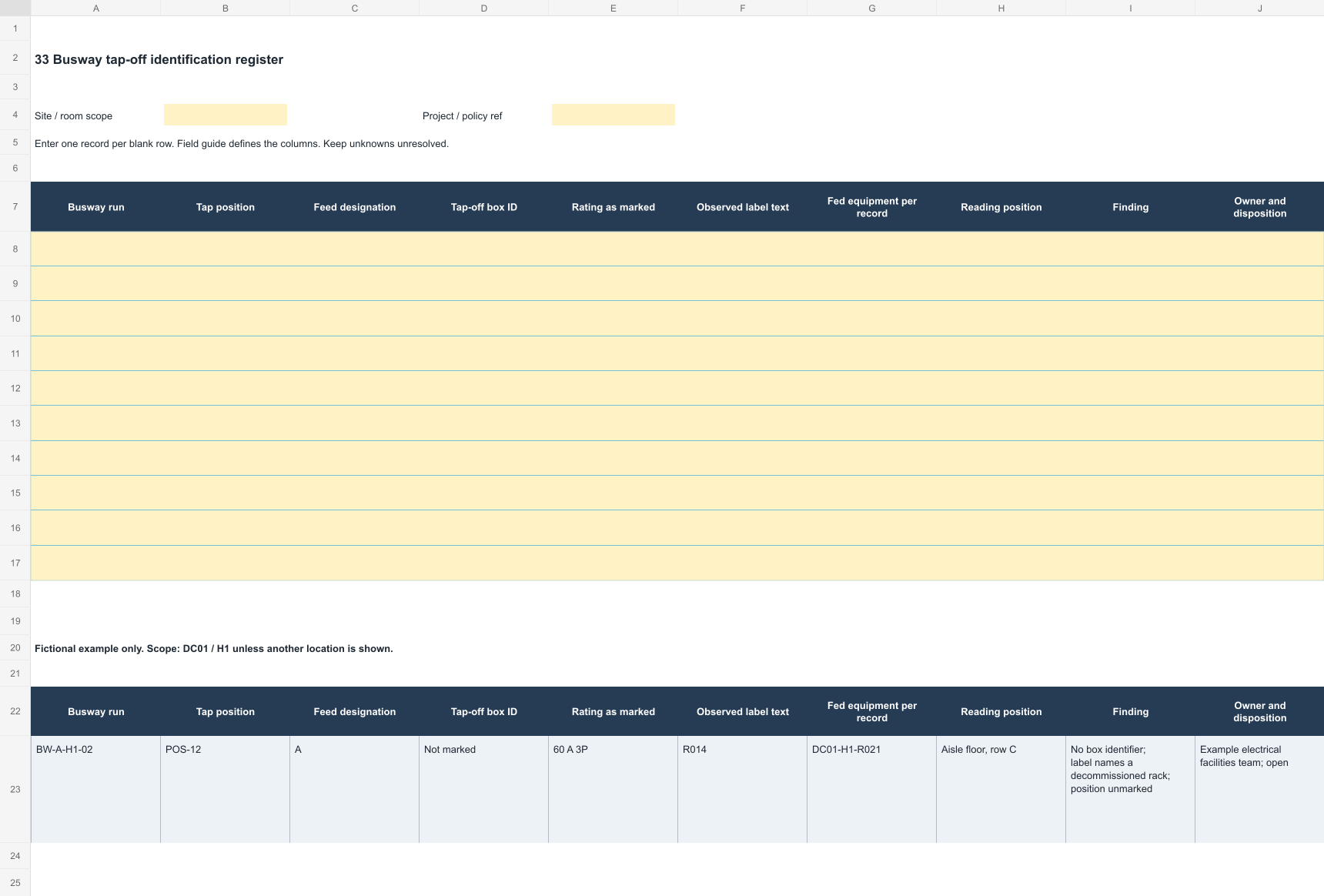
- Use the blank amber table for actual records. The fictional example below it is a reference.
- Insert table rows when needed. Keep identifiers as text, including leading zeros.
- Follow guide 33 to complete the checks and record unresolved items.
Before you start
- Settle in writing whether tap-off boxes are assets in your register or components of the run, because that decision changes every identifier in the survey and rooms that never make it end up running both conventions at once.
- Name the accountable owner for the busway system before the walk. Busway is frequently installed under a different scope of work than the panelboards it parallels, so an unnamed owner is a common and reportable finding in its own right.
- Collect the busway layout drawing at its current revision and the distribution record that says which equipment each position feeds, so the record rather than the label is the authority during the walk.
- Agree the reading position the survey will use for legibility, because a marking readable from a lift and a marking readable from the aisle floor are different observations.
Complete the register
- Enter one row per tap position in order from the feed end, including positions with no box, so the register describes the run rather than only the hardware presently hanging on it.
- Record the box identifier separately from the observed label text; a box whose only marking names a rack has an observed label and no identifier, and those are two different columns.
- Copy the rating exactly as the manufacturer marked it. Do not convert it, infer it from a neighbouring box, or complete it from the drawing.
- Take the fed equipment from the distribution record rather than from the label, and record the disagreement as a finding when the two differ.
- Photograph each position from the agreed reading position, so legibility is evidenced rather than asserted.
Walk through the example
Run BW-A-H1-02, position 12, feed designation A, box carrying the single marking R014 and a manufacturer rating of 60 A 3P.,The distribution record shows position 12 feeding DC01-H1-R021 and holds no entry for R014, which was decommissioned the previous quarter.,Three rows of findings result: the box carries no identifier of its own, the observed label names equipment that no longer exists, and position 12 carries no position marking, so the record cannot be verified from the field in either direction.,The reviewer issues no label. The register goes to electrical facilities with a photograph taken from the aisle floor and the date. Every identifier here is fictional.
Handle common exceptions
Review and close
- Route every finding to the named owner with the run, position, observed wording, rating, record reference, photograph, and date, and keep it open until the owner accepts a disposition.
- Leave the physical label in place until a correction is authorized. Removing a stale identifier leaves the position with no identification at all.
- Where a relocation is discovered with no change record behind it, raise that separately and treat it as the more significant finding, because the room and the distribution record have diverged without anyone noticing.
- Close a position only when the register, the distribution record, and the field agree, or when the owner has accepted a documented exception.
Fields and filled example
Fictional values only. Scope: DC01 / H1 unless another location is shown. The downloadable register is blank for your actual observations.
| Field | What to record | Fictional example |
|---|---|---|
| Busway run | Identifier marked on the busway housing for this run. | BW-A-H1-02 |
| Tap position | Fixed ordinal position on the run, counted from the feed end. Recorded whether or not a box is present. | POS-12 |
| Feed designation | Which side of the redundant pair this run is, as marked in the field. | A |
| Tap-off box ID | The box's own identifier, independent of its position and of what it feeds. Blank where the box carries none. | Not marked |
| Rating as marked | Rating exactly as marked by the manufacturer. Not converted, inferred, or completed from a similar box. | 60 A 3P |
| Observed label text | Identification wording visible on the box, copied exactly, including wording believed to be wrong. | R014 |
| Fed equipment per record | What the distribution record says this position feeds. Taken from the record, never from the label. | DC01-H1-R021 |
| Reading position | Where the observer stood to read the marking, because legibility depends on it. | Aisle floor, row C |
| Finding | What did not reconcile: missing box ID, missing position marking, label and record disagree, obscured factory marking, or none. | No box identifier; label names a decommissioned rack; position unmarked |
| Owner and disposition | Named accountable owner and the recorded outcome. Left open until the owner accepts it. | Example electrical facilities team; open |
Sources and scope
- UL Standards: UL 857, Busways ↗
Publisher listing for the busway product standard, fourteenth edition published September 10, 2025. Establishes that the scope covers busways and associated fittings including tap boxes, feed boxes and plug-in devices. No requirement, clearance, rating or marking text is reproduced here.
Read scope and linked guides - NFPA: NFPA 70, National Electrical Code ↗
Publisher code-development page for the installation code that carries field marking requirements. Adoption, edition and local amendments vary by jurisdiction; confirm what your project has adopted rather than assuming the latest edition.
Read scope and linked guides - OSHA: 29 CFR 1910.303 ↗
General electrical installation requirements including field marking of equipment. Cited for scope context, not as an identifier specification.
Read scope and linked guides - UL: Marking and Labeling Systems Program ↗
Publisher program page for label constructions evaluated for permanence on a stated surface and exposure. Cited because an overhead painted housing is a material decision; no test result or product claim is reproduced here.
Read scope and linked guides - TIA FOTC: TIA-606-D scope ↗
Publisher-affiliated scope overview for identifier administration. Cited to place identifier syntax and permanence with the document that covers them; the local scheme remains a local decision.
Read scope and linked guides - NFPA: NFPA 70B standard development and editions ↗
Publisher standard-development page for electrical equipment maintenance, current at 2026, issued November 19, 2025. Cited to separate equipment condition from label legibility; no maintenance task or interval is reproduced here.
Read scope and linked guides - NFPA: NFPA 70E standard development and editions ↗
Publisher standard-development page for electrical safety in the workplace, current at 2027. Cited to place safe work practices outside an identification survey, not as a source of label content.
Read scope and linked guides - OSHA: 29 CFR 1910.145 ↗
Specifications for accident prevention signs and tags. Cited to separate a temporary tag hung during work from permanent identification, which are different markings with different owners.
Read scope and linked guides - UL Solutions: UL 969A certification scope ↗
Publisher announcement for the flag and tag marking evaluation route. Cited because an overhead construction is a material decision; no test result or product claim is reproduced here.
Read scope and linked guides - TIA-942 official overview ↗
Publisher overview for the data center infrastructure standard. Cited for the context in which busway runs are documented, not as an identifier specification.
Read scope and linked guides