
The practical answer
A busway tap-off box is the only power device in a data hall designed to move, so identify four things separately: the run, the fixed tap position on it, the box with its own asset identifier, and the equipment it feeds, which belongs in the record rather than on the label. Mark the run and position on the busway so an empty position is still identified, put the box's identifier on the box, and record a relocation as a dated change instead of a trip to the printer. Manufacturer markings on the box belong to the evaluated product and are not yours to cover or replace.
The method, examples, and sources below explain the scope and checks.
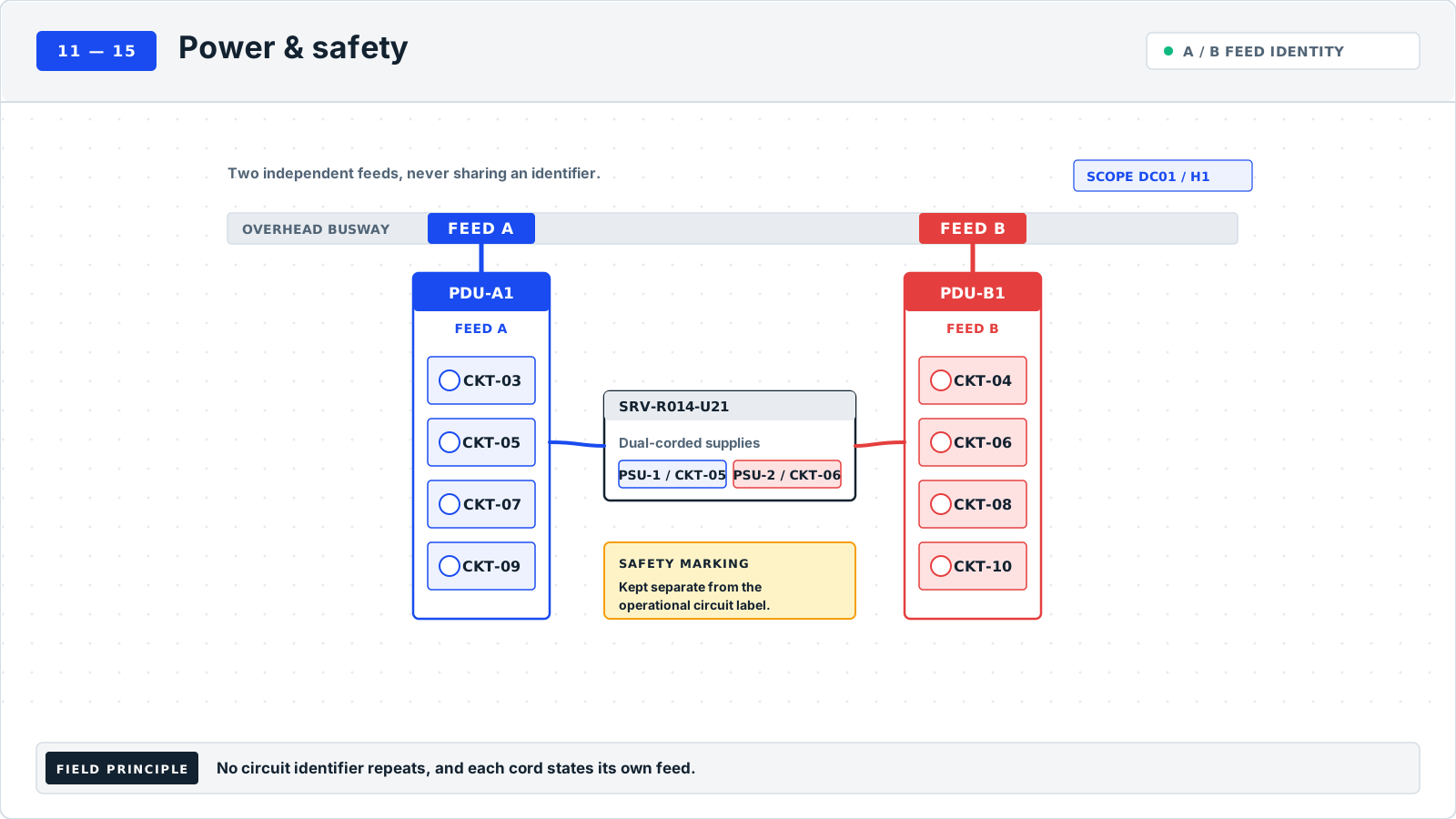
Examples are fictional local conventions. Unless another location is shown, the scope is DC01 / H1. Keep that scope with shortened identifiers.
When to use#
Use this survey when a rack goes dark and nobody can say which overhead box to open, when a walk of a busway run finds plug-in units that appear in no record, or when a move leaves two boxes apparently claiming the same position. It covers plug-in busway distributing power overhead in a data hall, and the tap-off boxes, plug-in units, and outlet boxes hanging from it.
It does not cover the busway's own factory markings, and it does not authorize opening, racking out, or de-energizing anything. This is an identification survey whose output is a record and, where something does not reconcile, an exception for the electrical owner.
What to gather#
Collect the busway layout drawing at its current revision, the power distribution record that says which equipment each rack position is fed from, the asset register entry for each tap-off box if one exists, and the name of the person accountable for the busway system. In a data center that last item is the one most often missing, because busway is frequently installed under a different scope of work than the panelboards and lands between two parties at handover.
Establish before you start whether the tap-off boxes are treated as assets in your records or as fittings belonging to the run. That single decision changes every identifier in the survey, and organizations that never make it end up with both conventions in the same room.
Four identities that get collapsed into one name#
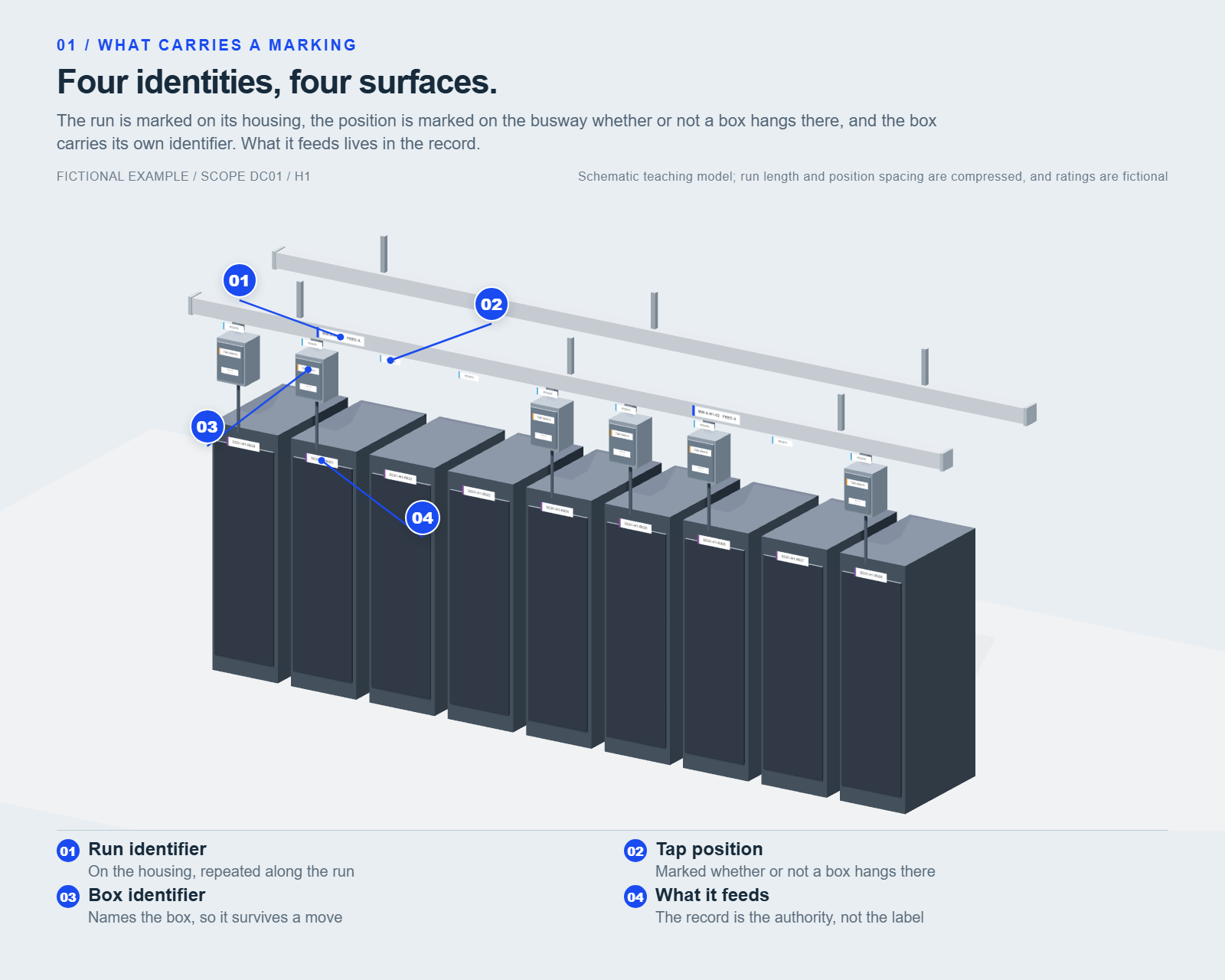
Almost every busway identification problem is the same problem: one label carrying one name for four different things that change on four different schedules.
| What it is | When it changes | Identified by | Where the identifier belongs |
|---|---|---|---|
| The busway run | Almost never, short of a room rebuild | A run identifier | On the busway housing, repeated along its length |
| The tap position | Never, because it is a place rather than a thing | The run identifier plus a position | On the busway at the tap point |
| The tap-off box | Every time somebody slides or relocates it | Its own asset identifier | On the box |
| The fed equipment | Whenever the load changes | The equipment identifier | In the record, not on the box |
The failure everybody has seen once: a box labeled R014 because it feeds rack R014. The rack is decommissioned, the box is reused three positions down for a rack called R021, and the label now names equipment that no longer exists in a position that is no longer correct. Nobody corrects it, because correcting it means deciding which of the four things the label was supposed to name, and that decision was never written down.
A busway tap-off box is the only power device in a data hall that is designed to move. Panelboard circuits stay where the panel is. A plug-in unit is built to be relocated along its run, which means any identifier that encodes where it currently is, or what it currently feeds, is guaranteed to go stale. Give the box an identity that travels with it, give the position an identifier that stays with the busway, and let a dated record carry the relationship between them.
What belongs to the manufacturer, and what belongs to you#
UL 857, current at its fourteenth edition published September 10, 2025, covers busways and their associated fittings, and its stated scope names tap boxes, feed boxes, and plug-in devices. The box is part of an evaluated product, not a bare enclosure that arrived with your cabinets.
That has a practical consequence for a labeling program. Orientation markings on the plug mast, the directional indicator that tells somebody which way a box releases, and the rating plate are the manufacturer's, applied under the evaluation the product carries. Your identification label is an addition to somebody else's product. Place it so it obscures none of theirs, and record a covered or illegible factory marking as an exception addressed to the equipment owner rather than reprinting it.
The distinction is the same one that separates a nameplate from a hazard label anywhere else in the room, and it is worth stating in the survey scope because the published writing about busway labeling is almost entirely about the manufacturer's own markings. A search for how to label a tap-off box returns instructions for aligning the mast label and reading the push or pull indicator. Those are real and useful, and they are not identification.
Requirements for field marking of installed equipment sit with the adopted electrical code, published as NFPA 70, the National Electrical Code, and with OSHA 29 CFR 1910.303. Neither is a labeling specification, and neither tells you what to call a box.
Label the run and the tap point, not only the box#
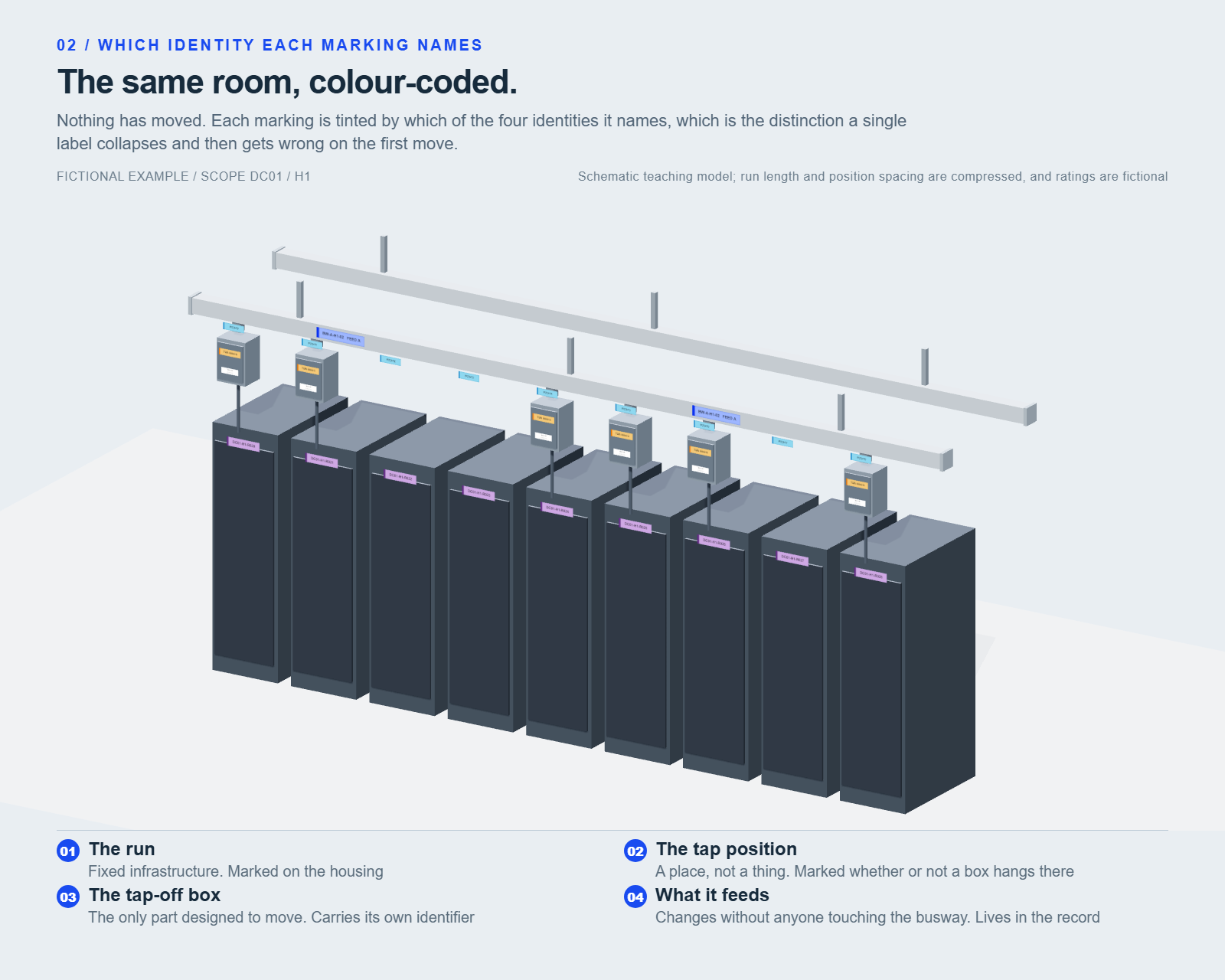
A box carrying a good identifier in a room with unlabeled busway still leaves somebody standing under thirty feet of aluminum with no way to say where they are. Identify the infrastructure first.
Mark the run identifier on the busway housing at intervals a person can find from the floor, at every change of direction, and at both ends. Mark the tap position at each tap point, so the position exists as a label whether or not a box is hanging there at the time. An empty position with a legible identifier is what lets a record say a box was removed rather than lost.
Position identifiers should be fixed and ordinal rather than derived from anything that can change. Numbering positions from the feed end in the direction of the run, and never renumbering, means a box moved from position 12 to position 15 produces two true statements and one dated change, instead of a renumbering exercise that invalidates every record referencing the old scheme. Follow the same rule your project already applies to identifier administration under the TIA-606 family: the syntax is a local decision, and permanence matters more than elegance.
Keep the A and B runs unambiguous where somebody reaches#
Overhead busway usually arrives in pairs, and the reason the pair exists is that one of them can be de-energized while the other carries the load. That only works if the person reaching up can tell which is which without tracing it back to the source.
Carry the feed designation on the run marking, on the position marking, and on the box, and make it readable from the working position rather than from the top of a ladder on the other side. Where two runs cross or turn, the marking interval matters more than anywhere else on the run, because that is where somebody reading the nearest label is most likely to read the wrong one.
A survey records what is legible from where a person actually stands. Note the reading position alongside the finding, because "labeled" and "legible from the floor beneath it" are different observations and only one of them is useful. Feed designation conventions, and the failure modes when the A and B sides disagree between records and the field, belong to the dedicated A and B feed guide; this survey only confirms that the designation is present, consistent, and readable at the box.
Which identifier scheme survives a move#
Three schemes turn up in the field. Only one of them still describes the room a year later, and the other two fail in ways that look like sloppiness but are really the scheme working as designed.
| Scheme | The box is called | It breaks when | What it costs to maintain |
|---|---|---|---|
| Position-encoded | Its place on the run, such as BW-A-02-POS12 |
The box is moved, which is what the box is built for | A reprint on every move, and a stale label whenever somebody skips one |
| Load-encoded | The thing it feeds, such as R014 |
The load changes or the rack is decommissioned, which happens more often than a move | A reprint on every rack change, and a label naming equipment that no longer exists |
| Device identity | Itself, such as TOB-000412 |
It does not, because the name describes the object rather than its circumstances | A record that must be kept, which you needed anyway |
Device identity wins for one reason, and it is not elegance. The first two schemes put a volatile fact into adhesive, which means the field and the record disagree the moment anybody does the job the equipment was designed for. The third puts the volatile facts in the record, where changing them is free and dated.
There is a real cost, stated plainly: a device identity tells a person standing under the busway nothing about what the box feeds. That answer has to come from a record they can reach. A program that adopts device identity and does not make the record reachable from the floor has moved the problem rather than solved it, and the survey should record whether that record is reachable at all.
What to mark, and where somebody can actually read it#
Marking the box is the part everyone does. The parts that make a survey possible are the ones on the infrastructure, because they are what lets a record refer to a place rather than to a thing that may have moved.
| What carries a marking | What it says | Where it goes | How often |
|---|---|---|---|
| Busway housing | The run identifier and the feed designation | On the underside or the face that a person sees from the aisle | Both ends, every change of direction, and at a readable interval along the run |
| Tap point | The run identifier and the fixed ordinal position | On the busway at the position, not on the box | Every position, occupied or not |
| Tap-off box | Its own device identifier and its feed designation | On the box face, clear of every factory marking | Once, and it travels with the box |
| The record | Which box is at which position, feeding what, since when | In the distribution record | Updated on every move, with a date |
The interval is a judgement rather than a number, and the test is observational: stand where the work happens and read the nearest marking. If the nearest legible run identifier is thirty feet away and the person has to walk to it and back, the interval is wrong regardless of what the specification said.
Record the reading position alongside every observation. "Labeled" and "legible from the floor beneath it" are different findings, and only the second one is worth anything to the person who has to act at two in the morning.
Record the move, because the box will move#
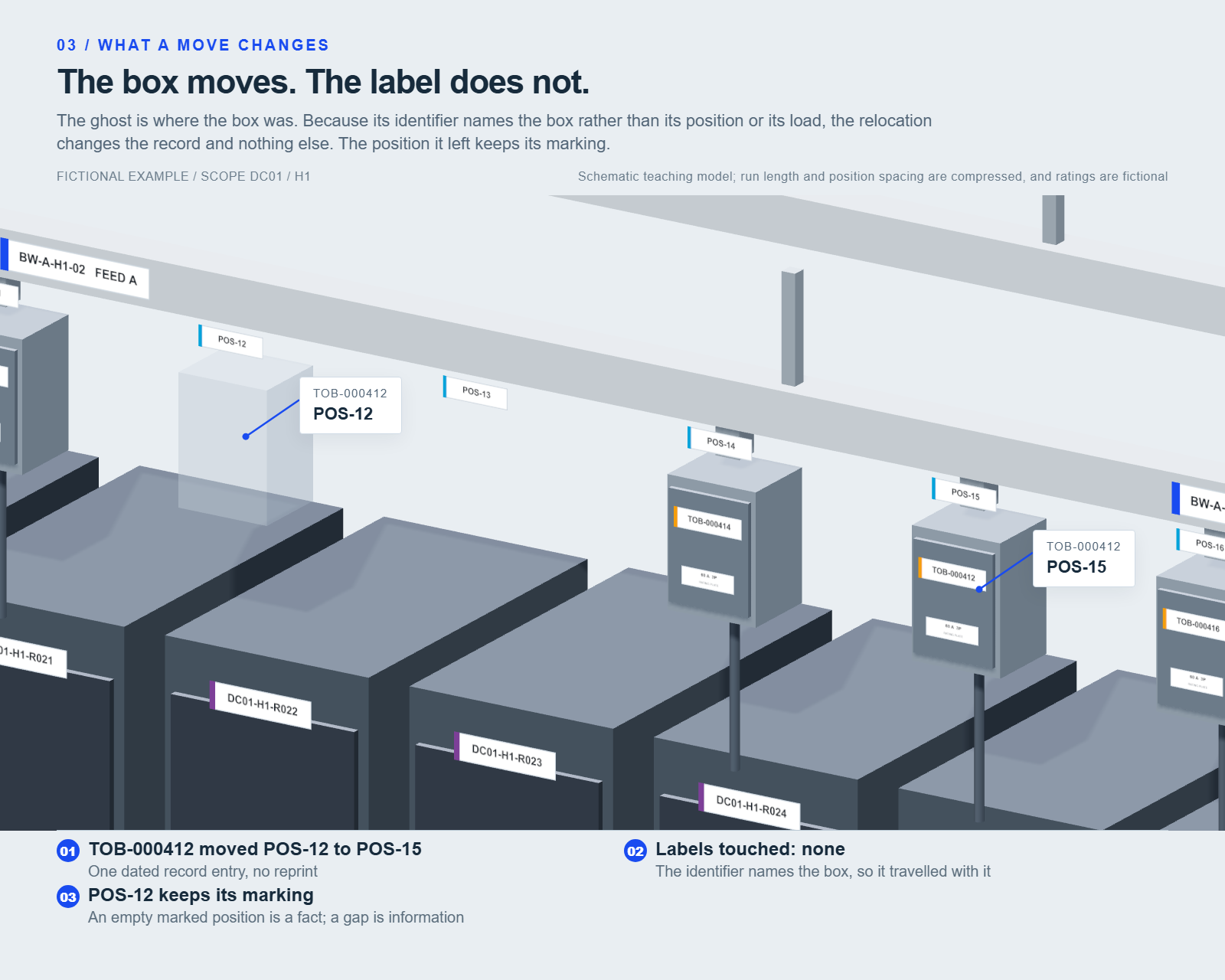
Treat a relocation as a records event with a date, not as a relabeling task. The minimum a record needs afterwards is the box identifier, the position it left, the position it now occupies, the equipment it now feeds, the date, and who did it. With those six facts the history reconstructs; without the date it does not.
Where the label on the box names the box rather than its position or its load, a move changes the record and leaves the label alone. That is the point of the scheme, and it is the fastest way to tell whether your identifiers are holding up: if a move requires a trip to the printer, the identifiers were encoding the wrong thing.
Attach the change to whatever change record authorized the work. A tap-off box that moved without one is a finding in its own right, and usually a more important one than any wording on its label, because it means the power distribution record and the room disagree and nobody noticed.
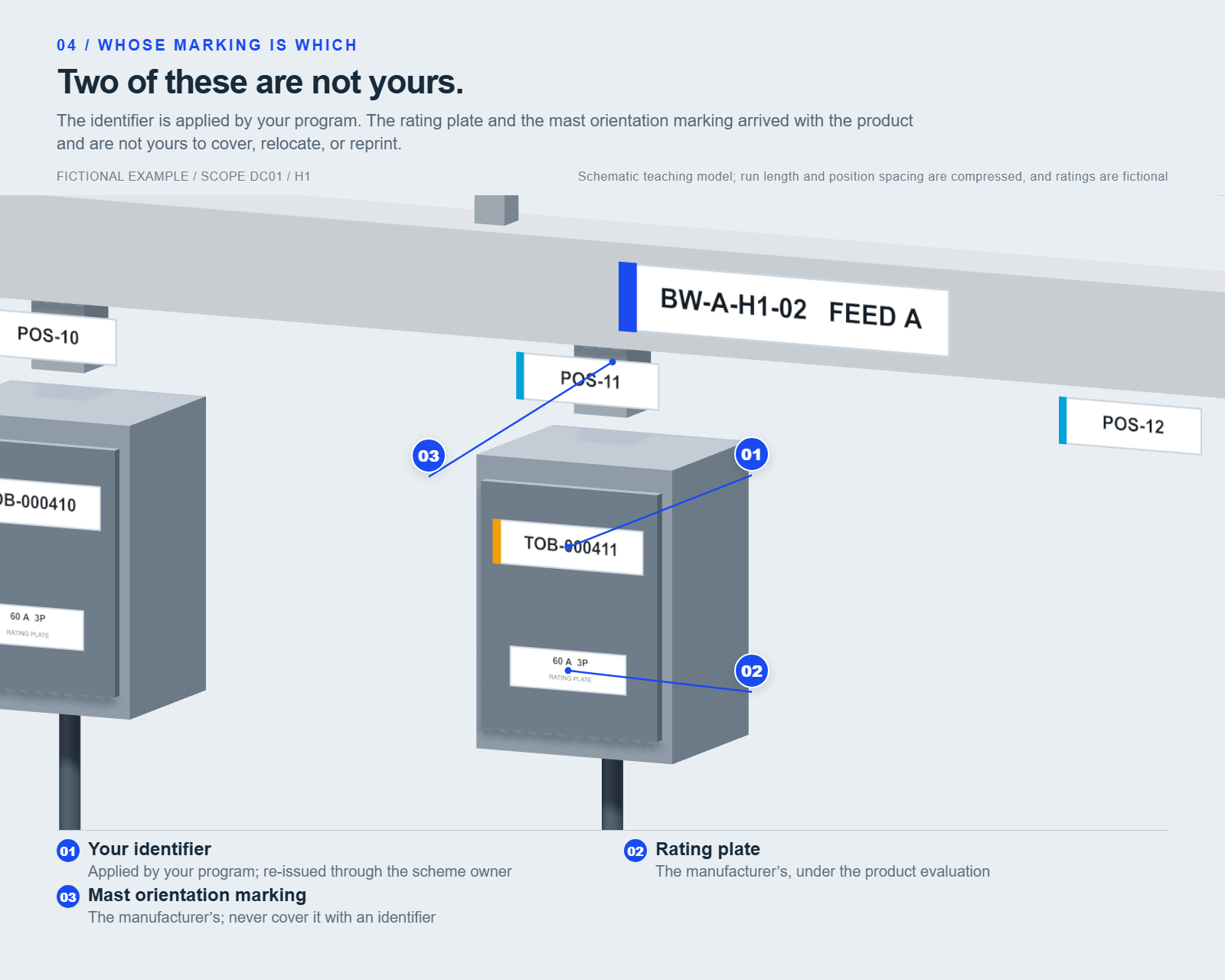
Markings on the box that are not yours to touch#
A tap-off box arrives with markings already on it, applied under the evaluation the product carries. Knowing which ones those are is the difference between adding an identifier and altering somebody else's product.
| Marking on the box | Who applied it | What a survey may do |
|---|---|---|
| Rating and identification plate | The manufacturer, under the product evaluation | Record it exactly as marked, and raise an exception if it is obscured or illegible |
| Orientation marking on the plug mast | The manufacturer, to set installation alignment | Leave it visible; never cover it with an identifier |
| Directional indicator for release | The manufacturer, so the box can be removed correctly years later | Leave it visible; record it as a finding if it has been painted over or covered |
| Your identification label | Your program | Place, correct, and re-issue it through the identifier scheme's owner |
| A temporary tag hung during work | Whoever hung it, for as long as it hangs | Record its presence and move on; it is not identification and is not yours |
UL 857, current at its fourteenth edition published September 10, 2025, covers busways and their associated fittings, and its stated scope names tap boxes, feed boxes, and plug-in devices. That is the basis for treating the factory markings as part of a product rather than as text on a box.
Temporary tags deserve their own line because they are the marking most often mistaken for identification. A tag hung during work is an accident-prevention marking with its own rules under 29 CFR 1910.145, applied by the person doing the work and removed by them. A survey records that one is present and does not evaluate, correct, or remove it.
What the installation is required to carry as permanent field marking is a different question again, answered by the adopted edition of NFPA 70 and by 29 CFR 1910.303, neither of which tells you what to call a box.
Identification workflow#
- Walk each run end to end and record the run identifier as it appears on the housing, including where it does not appear at all.
- Record each tap position in order from the feed end, whether or not a box is present.
- For each box, record its own identifier, its rating as marked by the manufacturer, and the feed designation shown on it.
- Record the equipment the box feeds from the distribution record, not from the label, and note where the two disagree.
- Photograph each box from the position a person would work from, so legibility is evidenced rather than asserted.
- Raise an exception for any box with no identifier, any position with no marking, any disagreement between label and record, and any obscured factory marking.
Where the survey stops#
An identification survey walks under energized overhead distribution. Its output is a record, and the boundary is worth writing into the scope before anybody starts, because the temptation to open one box and settle an argument is real.
| Question that comes up on the walk | Who answers it |
|---|---|
| What does this box feed? | The distribution record, checked afterwards, not the label and not by tracing conductors |
| Is this box the right rating for its load? | The electrical engineer of record |
| Can we open it to check the breaker position? | Nobody, on an identification survey. That is work, under the employer's electrical safety program |
| Is the busway in a condition that still matches the drawing? | The maintenance program, not a labeling walk |
| Who owns this run? | The question to settle before the survey, and a finding in its own right when nobody can say |
Safe work practices and the qualification to perform them sit with the adopted edition of NFPA 70E and the employer's electrical safety program. Nothing in an identification survey authorizes opening an enclosure, and a survey that finds itself needing to is a survey whose scope was drawn wrong.
Condition is a separate discipline from identification, and the two get conflated on a busway walk because both involve looking at the same hardware. Maintenance of electrical equipment has its own document, published as NFPA 70B and current at its 2026 edition, issued November 19, 2025. A labeling survey can record that a marking is illegible because the housing is dirty. It cannot conclude anything about the equipment behind it.
Materials for an overhead position#
The deciding properties for a label at height are not the ones that matter at a patch panel. Adhesion is to a painted or powder-coated aluminum housing rather than to a jacketed cable, the surface runs warmer than ambient, and the reading distance is measured from the floor rather than from arm's length.
Character height follows reading distance, and reading distance on a busway run is whatever the aisle floor is below it, which is usually three to four metres rather than the half-metre a rack label is designed for. A label sized for a cabinet face and applied overhead is legible only from a lift, which means it is illegible during the incident it exists for.
Evidence that a construction was evaluated for a given surface and exposure attaches to that specific construction through the manufacturer's marking and labeling system, and flag and tag constructions have their own evaluation route. A category of label carries no such evidence, and neither does a roll that happens to be loaded in the printer.
The data center context for how these runs are documented in the first place sits with the data center infrastructure standard, while the identifier syntax and its permanence belong to the administration family. Neither writes your naming scheme.
Worked example: a box that outlived the rack it was named for#
In fictional DC01 / H1, busway run BW-A-H1-02 carries plug-in units above rows C and D. Position 12 holds a 60 A box whose only identification label reads R014. The distribution record shows rack DC01-H1-R021 fed from run A at position 12, and shows no entry for a rack called R014, which was decommissioned in the previous quarter.
The survey records three separate findings rather than one. First, the box carries no identifier of its own, so it cannot be tracked across a move; that is a scheme exception, not a wrong label. Second, the label names equipment that does not exist, which is a records disagreement between the field and the distribution record. Third, position 12 on the busway carries no position marking at all, so the record's claim about position 12 cannot be verified from the field in either direction.
The reviewer issues no new label at the box. The record goes to the named electrical owner with the run, the position, the observed label text, the rating as marked, the distribution record reference, a photograph taken from the aisle floor, and the date. What the label should say is a decision for the owner of the identifier scheme. Every identifier in this example is fictional.
Common mistakes#
- Naming a movable box after the rack it currently feeds, which guarantees the label goes stale on the first move.
- Numbering tap positions by the equipment below them, so a rack rename silently renumbers the busway.
- Renumbering positions after a removal to close the gap, which invalidates every record that referenced the old numbers.
- Applying your own label over the manufacturer's orientation marking or rating plate.
- Recording a move by reprinting the label and changing nothing in the record.
- Treating the absence of a box at a marked position as a missing label rather than as a state the record should already describe.
Verification#
Worksheet: Busway tap-off identification register#
Record one row per tap position, including positions with no box, so the register describes the run rather than only the hardware currently on it. Keep the observed label wording exactly as seen, including wording you believe is wrong, because the survey's value is the difference between what is written and what the record says.
Label constructions for an overhead position are their own decision: adhesion on a painted aluminum housing at height, and legibility at a reading distance measured from the floor rather than from arm's length, are the deciding properties. Evidence that a construction was evaluated for a given surface and exposure sits with the manufacturer's marking and labeling system for that construction, not with a category of label.
FAQs#
Should the label on the box name the rack it feeds?#
No, and this is the single decision that determines whether the scheme survives. The box moves and the load changes, so a label naming either one is wrong as soon as anything happens. Put the box's own identifier on the box, the position identifier on the busway, and the relationship between them in a dated record. If somebody needs to know what a box feeds while standing under it, that is an argument for a readable record on a phone, not for encoding a volatile fact in adhesive.
What if our tap-off boxes are not in the asset register at all?#
Record that as the finding, because it is a bigger one than any label. A device that is not in the register cannot be tracked across a move, cannot be matched to a rating, and cannot be reported as present or missing at the end of a quarter. Whether busway fittings should be assets or components of the run is a policy decision for the asset owner; the survey's job is to say which convention the room is actually using, and to note where both are in use at once.
Can we relabel a box in the field when we find it wrong?#
Only where the identifier scheme's owner has already decided what it should say. Correcting a label is quick and creates a new claim about the installation, which is why it belongs to the scheme owner rather than to the person holding the printer. Record the observation, route it, and leave the physical label in place until the correction is authorized; removing it leaves the position with no identification at all, which is worse than a stale one.
Is a tap-off box covered by the same standard as the busway?#
The publisher's scope for the busway product standard names tap boxes, feed boxes, and plug-in devices alongside the busway itself, so the fittings are part of the same evaluated product. That matters to a labeling program for one reason: the markings the manufacturer applied are part of that product and are not yours to replace, relocate, or cover. What the installation is required to carry as field marking is a separate question, answered by the adopted electrical code rather than by the product standard.
How do we identify an empty tap position?#
As a position, with its own marking, and as a row in the register with no box recorded against it. An unmarked empty position is indistinguishable from a position that never existed, which means a removed box cannot be told apart from a lost one. This is also why positions should never be renumbered after a removal: the gap is information.
The busway was installed by a different contractor. Whose labels are these?#
That is the question to settle in writing before the survey produces anything, and the most common reason busway ends up with neither identification nor an owner. Busway frequently arrives under a different scope of work than the panelboards it parallels, so it falls between two handovers. Where no owner is named, the first finding of the survey is the missing owner, and the identification exceptions attach to it rather than to a name somebody guessed.
If the box identifier says nothing about the load, how does anyone find the right box at 2am?#
From a record they can reach without a laptop, which is the trade the scheme makes and the obligation it creates. Device identity moves the volatile facts into the record, so the record has to be reachable from the aisle floor on a phone. A program that adopts device identity and leaves the record in a spreadsheet on somebody's desktop has relocated the problem rather than solved it, and the survey should record whether the record is reachable at all.
Do we need to mark a position that has never had a box on it?#
Yes, and it is the marking most often skipped. An unmarked empty position is indistinguishable from a position that does not exist, so a removed box cannot be told from a lost one and a record claiming a box sits at position 12 cannot be checked in either direction. The marking is what makes absence a fact rather than a gap in the survey.
Our positions were renumbered after a removal. What now?#
Stop renumbering, then reconcile once. Every record that referenced the old numbers is now ambiguous, and the only way out is a dated crosswalk from old numbering to new, kept permanently rather than treated as a migration artifact. Then fix the rule: positions are ordinal from the feed end and never reused, never closed up, never renumbered. The gap a removal leaves is information about the run.
Can the survey tell us whether a box is correctly rated for what it feeds?#
No, and the boundary matters. The survey records the rating exactly as the manufacturer marked it and records what the distribution record says the box feeds. Whether those two are compatible is an engineering judgement belonging to the electrical engineer of record. A labeling program that starts assessing ratings has quietly changed what it is, and its records stop being defensible as observations.
The busway housing is dirty and the run marking is unreadable. Is that a labeling finding?#
Record it as an observation with the reason, because the reason decides where it routes. A marking that is illegible because the housing needs cleaning is a housekeeping or maintenance referral; a marking that is illegible because the label has failed is a materials finding; a marking that was never applied is a scheme finding. Three different owners, three different fixes, and a survey that records only "unreadable" sends all three to the wrong person.
Should tap-off boxes be in the asset register or treated as parts of the run?#
Either can work, and running both at once cannot. Treating them as assets gives each box a register entry, a rating, and a history across moves, which is what most data centers eventually want. Treating them as components of the run is simpler and makes moves invisible, which is fine until somebody asks where a specific box has been. Make the decision explicitly, write it down, and record in the survey which convention the room is actually using, because rooms that never decided are usually using both.
Who owns busway labels when the busway came with the building?#
Settle it in writing before the survey produces anything, because busway installed under a base-building or shell scope is the most common case of infrastructure nobody in the operating organization thinks they own. Where no owner can be named, the first finding of the survey is the missing owner and every identification exception attaches to it. Naming a plausible owner who has not accepted the role produces a list of exceptions addressed to somebody who will not act on them.
More worked label examples
Two additional ways to apply this guide. Keep the exact identifiers and relationships consistent with your own approved records.
GUIDE 33 / EXAMPLE 1
Separate the box, the position, and the load it feeds
One box carrying one name for three different things. The register splits them and leaves the label alone until the scheme owner decides.
SCOPE: DC01 / H1; run BW-A-H1-02, position 12
OBSERVED AT THE BOX
[LABEL: R014]            [RATING AS MARKED: 60 A 3P]
[BOX ID: none]          [FEED DESIGNATION: A]

OBSERVED ON THE BUSWAY
[RUN: BW-A-H1-02]       [POSITION MARKING: none]

DISTRIBUTION RECORD r7
BW-A-H1-02 / POS-12 -> feeds DC01-H1-R021
R014 -> no current entry; decommissioned prior quarter

FINDINGS BW-A-H1-02-12
1 box carries no identifier of its own
2 observed label names equipment that no longer exists
3 tap position carries no marking, so the record is unverifiable
Owner: electrical facilities; status: open
Read from: aisle floor, row C- The observed label text and the box identifier are separate columns. A box whose only marking names a rack has an observed label and no identifier, which is why the finding is a scheme exception rather than a wrong label.
- The rating is copied exactly as the manufacturer marked it. It is not converted, inferred from a neighbouring box, or completed from the drawing.
- No label is issued in the field. What the box should be called is a decision for the owner of the identifier scheme; every identifier shown here is fictional.
GUIDE 33 / EXAMPLE 2
Record a relocation without reprinting anything
The box moves three positions down the run. Because its identifier names the box rather than its position or its load, the move changes the record and nothing else.
SCOPE: DC01 / H1; run BW-A-H1-02
BEFORE
POS-12 [TOB-000412] -> feeds DC01-H1-R021
POS-15 [empty, marked]

MOVE CHG-2026-0418, 2026-04-18, by facilities electrical
TOB-000412: POS-12 -> POS-15
New load: DC01-H1-R027

AFTER
POS-12 [empty, marked]
POS-15 [TOB-000412] -> feeds DC01-H1-R027

LABELS TOUCHED: none
The box label reads TOB-000412 before and after.
Positions keep their original ordinal numbers; the gap is information.- The six facts a relocation record needs are the box identifier, the position it left, the position it now occupies, the equipment it now feeds, the date, and who moved it. Without the date the history does not reconstruct.
- Positions are never renumbered to close a gap. An empty marked position is what distinguishes a removed box from a lost one.
- If a move requires a trip to the printer, the identifiers were encoding the wrong thing. Every identifier shown here is fictional.
Sources and applicability
- UL Standards: UL 857, Busways ↗
Publisher listing for the busway product standard, fourteenth edition published September 10, 2025. Establishes that the scope covers busways and associated fittings including tap boxes, feed boxes and plug-in devices. No requirement, clearance, rating or marking text is reproduced here.
Read scope and linked guides - NFPA: NFPA 70, National Electrical Code ↗
Publisher code-development page for the installation code that carries field marking requirements. Adoption, edition and local amendments vary by jurisdiction; confirm what your project has adopted rather than assuming the latest edition.
Read scope and linked guides - OSHA: 29 CFR 1910.303 ↗
General electrical installation requirements including field marking of equipment. Cited for scope context, not as an identifier specification.
Read scope and linked guides - UL: Marking and Labeling Systems Program ↗
Publisher program page for label constructions evaluated for permanence on a stated surface and exposure. Cited because an overhead painted housing is a material decision; no test result or product claim is reproduced here.
Read scope and linked guides - TIA FOTC: TIA-606-D scope ↗
Publisher-affiliated scope overview for identifier administration. Cited to place identifier syntax and permanence with the document that covers them; the local scheme remains a local decision.
Read scope and linked guides - NFPA: NFPA 70B standard development and editions ↗
Publisher standard-development page for electrical equipment maintenance, current at 2026, issued November 19, 2025. Cited to separate equipment condition from label legibility; no maintenance task or interval is reproduced here.
Read scope and linked guides - NFPA: NFPA 70E standard development and editions ↗
Publisher standard-development page for electrical safety in the workplace, current at 2027. Cited to place safe work practices outside an identification survey, not as a source of label content.
Read scope and linked guides - OSHA: 29 CFR 1910.145 ↗
Specifications for accident prevention signs and tags. Cited to separate a temporary tag hung during work from permanent identification, which are different markings with different owners.
Read scope and linked guides - UL Solutions: UL 969A certification scope ↗
Publisher announcement for the flag and tag marking evaluation route. Cited because an overhead construction is a material decision; no test result or product claim is reproduced here.
Read scope and linked guides - TIA-942 official overview ↗
Publisher overview for the data center infrastructure standard. Cited for the context in which busway runs are documented, not as an identifier specification.
Read scope and linked guides