
The practical answer
No single standard governs data center labeling. TIA-606-D administers identifiers, records, relationships and reports for telecommunications infrastructure; electrical marking, hazard signs, pipe identification and label-material qualification come from separate documents with separate owners. Map each label class to its governing document, record the adopted edition and the evidence actually reviewed, and keep local identifier syntax an explicit local decision.
The method, examples, and sources below explain the scope and checks.
Which standards actually govern a data center label#
Use the identifier builder to preview your chosen segments and export a fictional trial range before producing the approved identifiers.
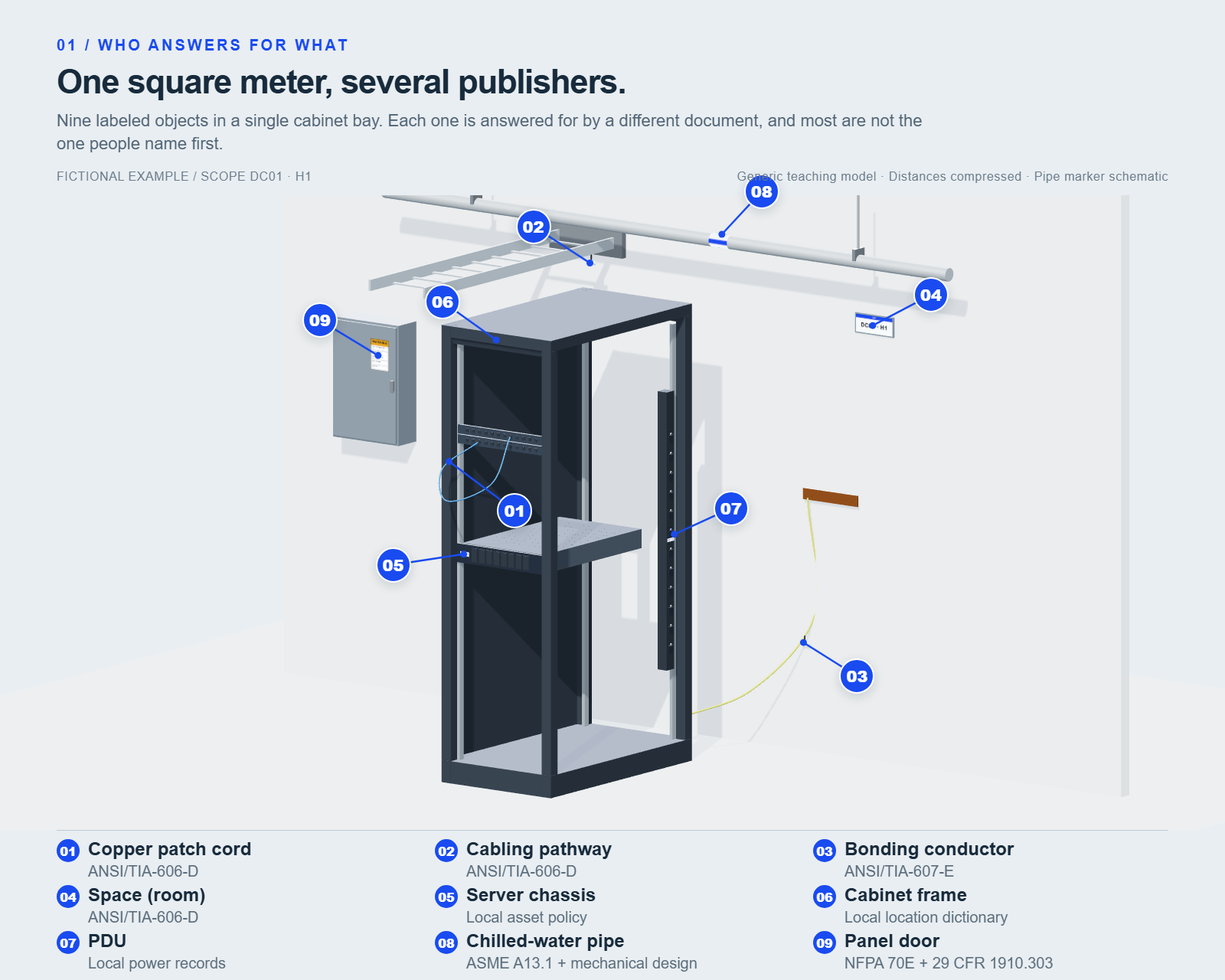
A request to "follow the labeling standard" usually names one document and depends on several. Identifier administration, electrical field marking, hazard communication, pipe identification, and label-material qualification are published by different bodies, adopted by different routes, and owned inside your organization by different people. A cabinet ID, an arc flash label, and a chilled-water pipe marker can sit within a meter of each other and share no governing document at all.
The table routes a labeling question to the publisher that addresses it. Each entry states the document's subject as its publisher describes it. No requirement text is reproduced here, and none of these entries decides applicability for your project.
| Labeling question | Document whose subject covers it | What it still does not decide |
|---|---|---|
| How are identifiers, records, relationships, and reports administered? | ANSI/TIA-606-D, administration for telecommunications infrastructure | Your local identifier syntax, or approval of any specific string |
| What belongs in data center infrastructure design? | TIA-942, Revision C | Label content, or a naming grammar |
| How is the bonding and grounding system identified? | ANSI/TIA-607-E | Which conductors your design actually installed |
| What marking must installed electrical equipment carry? | NFPA 70, as adopted and amended by the jurisdiction | Whether a given installation complies |
| What does an electrical safety marking have to communicate? | NFPA 70E with 29 CFR 1910.303 | The values on the label, which come from the responsible analysis |
| What belongs on an accident-prevention sign or tag? | 29 CFR 1910.145 | Whether an operational asset tag is in scope at all |
| How are aboveground pipes identified by fluid? | ASME A13.1 | Electrical conduits, which its overview excludes |
| Is this label construction evaluated for the surface and exposure? | UL marking and labeling systems, with UL 969A for flag and wrap products | Whether your printer, ink, and surface combination was the evaluated one |
| How does an automated infrastructure management system exchange data? | ISO/IEC 18598:2016 | What your installed hardware can actually detect |
| What will an assessor expect the labels to evidence? | The adopted control set, such as NIST SP 800-53 PE-10 | Whether the control is satisfied, which is the control owner's decision |
Only the first row is about identifier administration. The rest arrive through electrical design, facilities engineering, procurement, or an audit program, and each has an owner who is not the person printing labels. A project that treats every row as "the labeling standard" produces one spreadsheet with one approver and no way to show where any individual value came from.
Use the table to find the owner before you settle the format. If a row has no named owner on your project, that is the gap to close first. The electrical safety row is the one that most often arrives already wrong, because the editions move and the field does not follow: checking a hazard label against the document that produced it is a separate method with its own routing and its own current editions.
What TIA-606 specifies, and what it leaves to you#
The TIA FOTC overview describes ANSI/TIA-606-D as the work of the TR-42.3 subcommittee, published in October 2021, covering administration systems for telecommunications infrastructure within and between buildings, and naming commercial, industrial, residential and data center premises within that scope. ANSI/TIA-606-D overview.
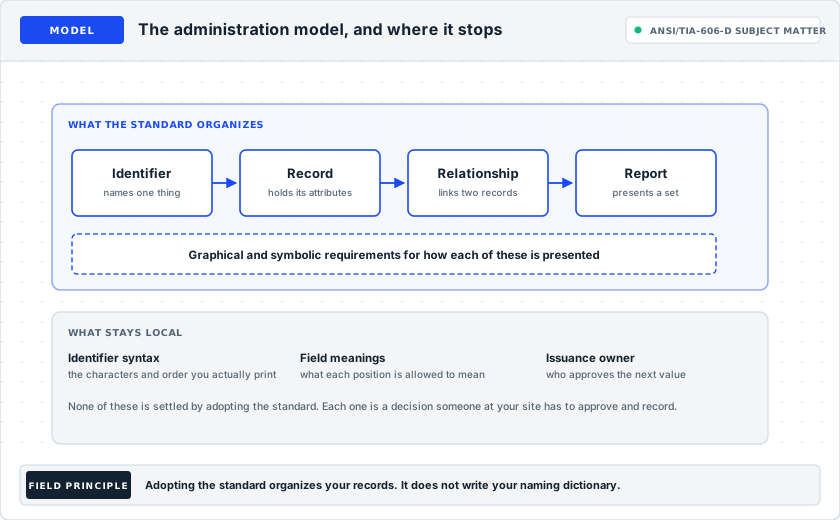
The same overview describes an administration system as five things: identifiers assigned to components of the infrastructure, the elements of information that make up a record for each identifier, the relationships between those records, the reports that present information across groups of records, and graphical and symbolic requirements.
Read that as the shape of your documentation rather than as label artwork. It says that a label is one visible face of a record, and that the value of the record comes from its relationships and from the reports you can produce. It does not tell you that a cabinet should be called CAB-G01-101. That decision stays local, which is why a site still needs an approved dictionary and a named issuance owner.
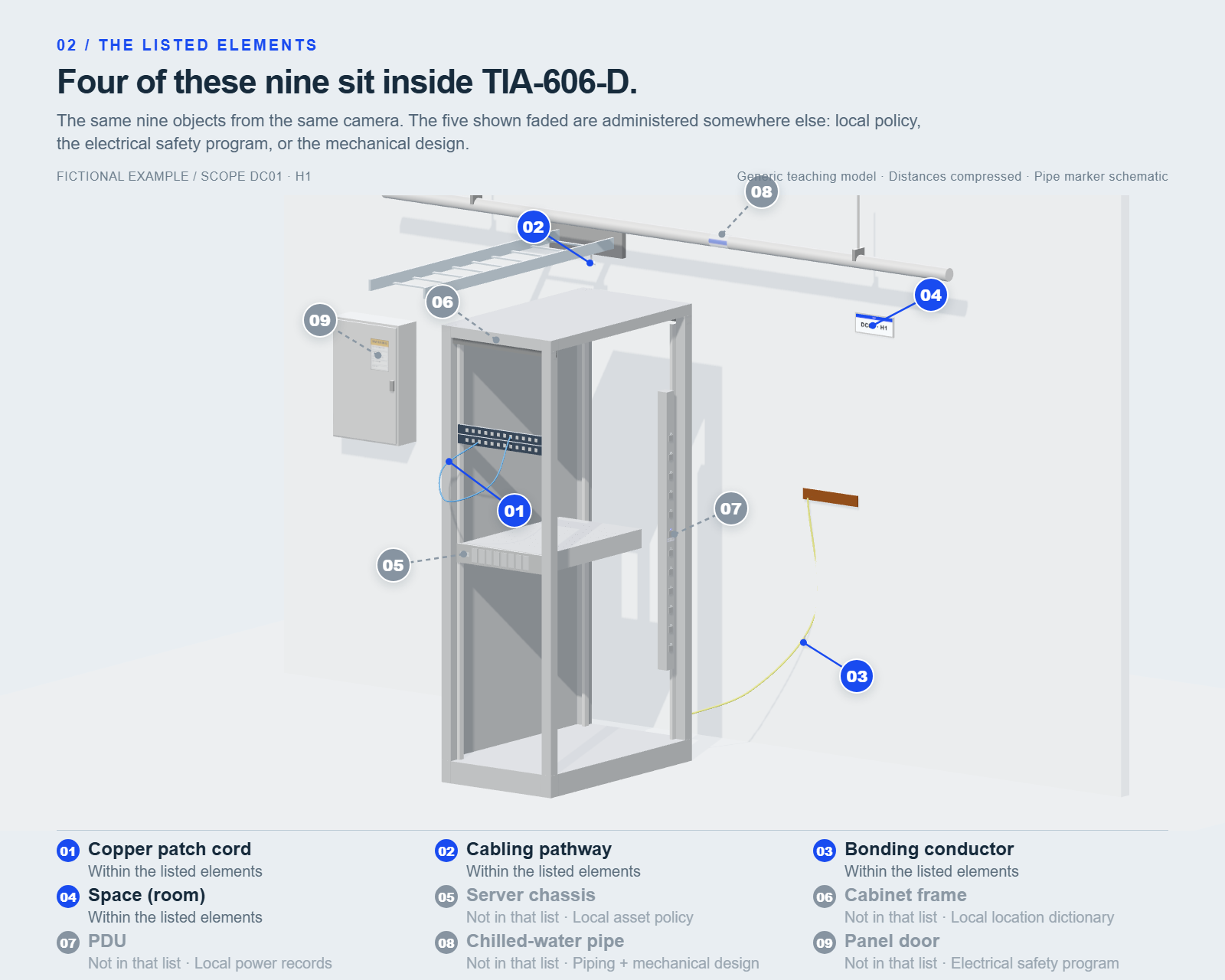
The overview also lists the infrastructure elements that the administration system covers: cabling subsystem pathways and cabling, telecommunications bonding and grounding, spaces such as entrance facilities, telecommunications rooms and equipment rooms, and fire-stopping.
Compare that list against what actually carries a label in a running hall. The gap is the point.
| Object you label in the hall | Within the listed administration elements | Where its rule actually comes from |
|---|---|---|
| Structured cabling pathway and cable | Yes | Adopted administration edition plus the local dictionary |
| Telecommunications bonding conductor | Yes | Administration edition with the bonding and grounding design |
| Entrance facility, telecommunications room, equipment room | Yes | Administration edition with the approved floor drawing |
| Fire-stopping penetration | Yes | Administration edition with the fire-stopping submittal |
| IT asset tag on a server or switch | Not in that list | Local asset policy and intake procedure |
| Cabinet position address on the floor | Not in that list | Local location dictionary and room drawing |
| PDU outlet to power-supply relationship | Not in that list | Local power records and the electrical design |
| Chilled-water pipe, hose, or isolation valve | Not in that list | Piping identification plus the approved mechanical design |
| Arc flash or hazard label | Not in that list | The electrical safety program and its analysis |
Nothing in that right-hand column is optional work, and none of it becomes correct because a cabling administration standard was named in the specification. Treat the standard as authoritative for what it administers and explicit about everything else. The naming convention guide covers the local dictionary the standard expects you to supply, and asset tagging at intake covers the identity that begins before a cable exists.
Choosing a class of administration#
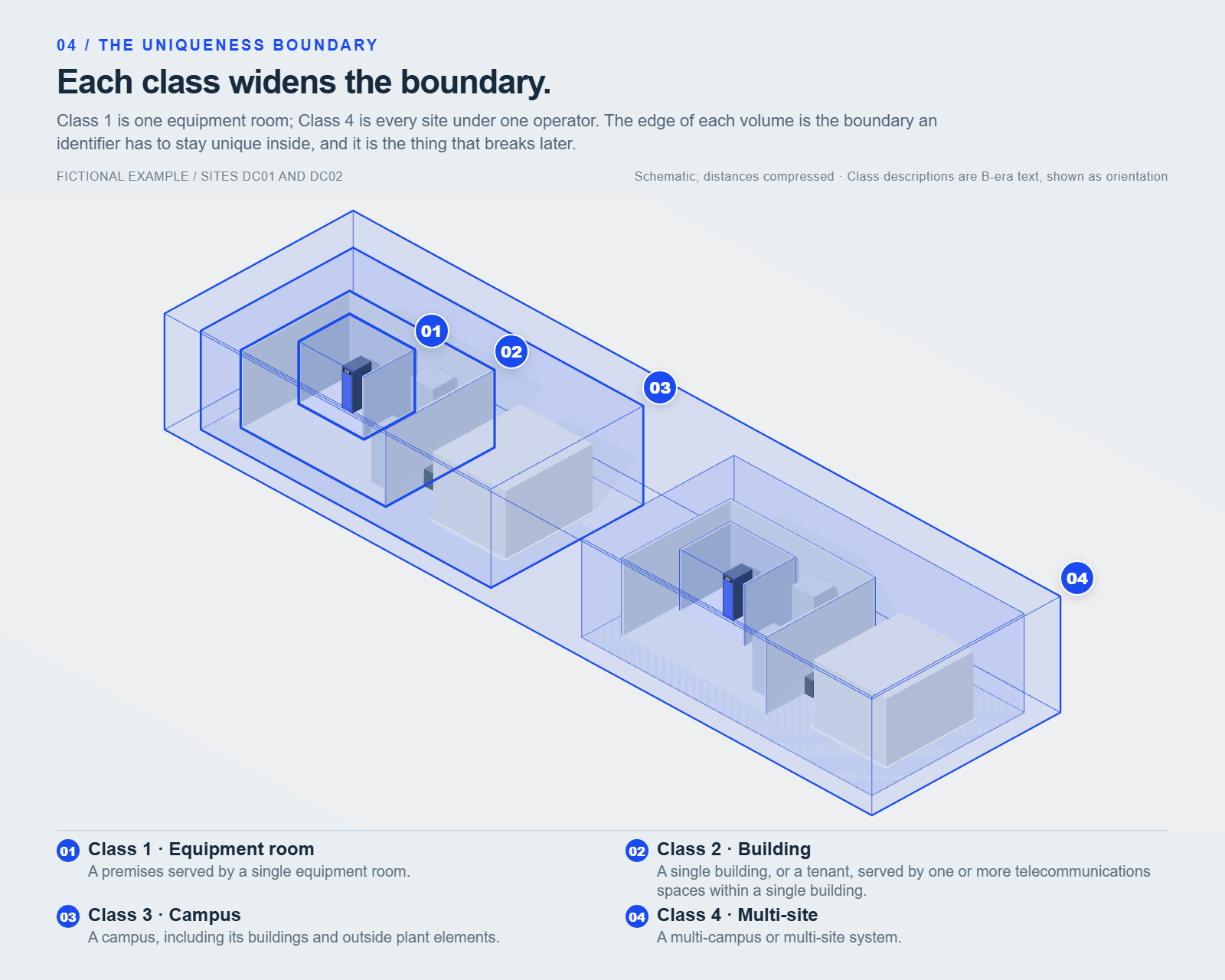
The overview lists four classes of administration, with Class 1 carrying the least stringent and Class 4 the most stringent requirements, and identifies the size and complexity of the cabling plant as the most relevant consideration when determining the minimum class. Its descriptions are:
- Class 1 covers a premises served by a single equipment room.
- Class 2 covers a single building, or a tenant, served by one or more telecommunications spaces within a single building.
- Class 3 covers a campus, including its buildings and outside plant elements.
- Class 4 covers a multi-campus or multi-site system.
Take those as orientation to the class model rather than as a verified statement of the current edition's class requirements. On the overview page the class descriptions sit under a heading that identifies them as B-era text, so confirm the class obligations against the edition your project has actually adopted before writing them into a specification.
The practical consequence is about uniqueness scope rather than stringency in the abstract. Each step up the classes widens the boundary within which an identifier has to stay unique, and that boundary is what breaks later.
| Your situation | Class the model points at | The question it forces |
|---|---|---|
| One hall, one equipment room, one operator | Class 1 territory | Is the room's own sequence enough, and who issues the next value? |
| Several halls and telecommunications rooms in one building | Class 2 territory | Does the hall appear in the identifier, or only in the record? |
| A campus with outside plant between buildings | Class 3 territory | Which field distinguishes buildings, and who owns it across them? |
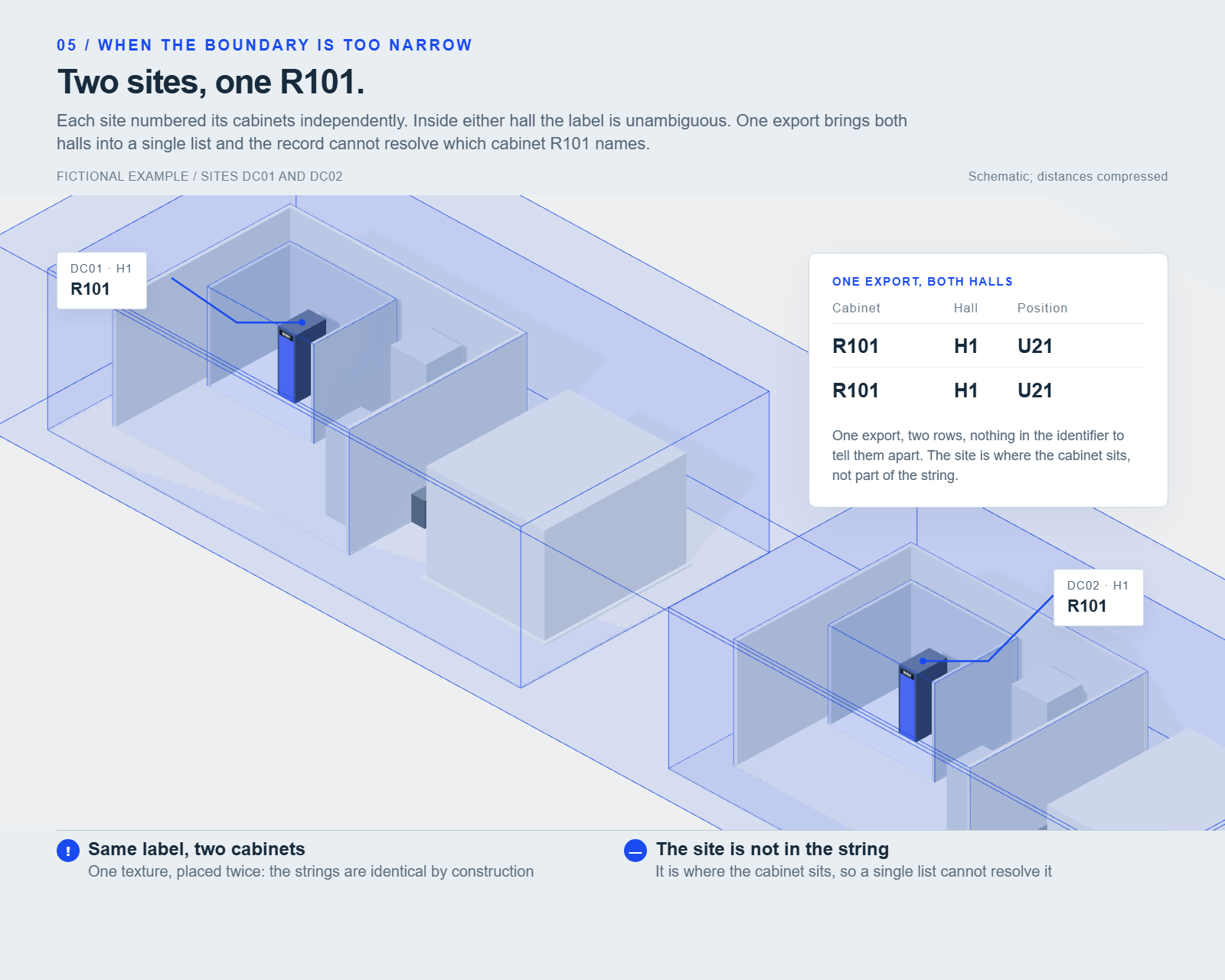
| Two or more sites under one operator | Class 4 territory | Is R101 unique across the estate, or only inside one site? |
A fictional operator running DC01 and DC02 shows the failure. Each site independently numbers cabinets from R101. Inside either hall the labels are unambiguous. The moment a shared change ticket, a remote-hands request, or a single export brings both halls into one list, R101 names two cabinets and the record cannot resolve which. Deciding the class early is what prevents that, because it settles the uniqueness boundary before several thousand labels exist.
Record the class decision together with the reason for it. A later reviewer needs to know whether Class 2 was chosen because the estate genuinely is one building, or because nobody asked about the second site yet. The multi-site prefix and alias register holds that boundary once it is agreed, and duplicate identifiers covers the repair when it was not.
Editions: a TIA-606-B reference is not a current requirement#
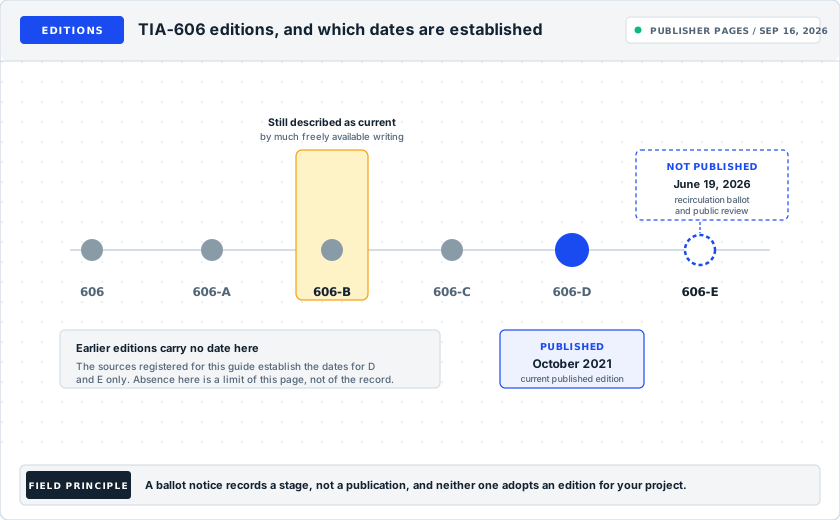
A large amount of freely available writing about data center labeling still describes ANSI/TIA-606-B. Some of it is a decade old and reads as current. The publisher overview cited above covers D, published in October 2021, and records that D moved the annex on administration of remote powering into a new normative clause harmonized with the AIM addendum. A reader working from B-era material will not know that clause exists.
Development has continued. TIA issued a recirculation ballot and public review notification for TIA-606-E on June 19, 2026. TIA-606-E ballot notice. That notice establishes the stage the document had reached and the date it reached it. It is not publication, it is not the text, and it is not adoption by your project.
Those are three separate facts, and a source register that collapses them produces arguments nobody can settle.
The three editions this page can speak to, and what a registered source establishes about each:
| Edition | Status | Date a registered source establishes |
|---|---|---|
| ANSI/TIA-606-B | Not the current edition. Most freely available writing about data center labeling still describes it | None. The sources registered here do not establish its date |
| ANSI/TIA-606-D | The current published edition named by the publisher overview cited on this page | Published October 2021 |
| ANSI/TIA-606-E | Not published. A recirculation ballot and public review notification had been issued | Notice dated June 19, 2026 |
Editions 606, 606-A and 606-C exist in the series and are not current. This page asserts no dates for them, because the sources registered here do not establish any. Treat that absence as a limit of this page rather than as evidence that no date exists.
| Question | What answers it | Evidence to retain |
|---|---|---|
| Which edition is published? | The publisher's own catalog or announcement | Publisher page, with the date it was read |
| Which edition did this project adopt? | The project specification or local standard | The specification clause and its revision |
| Which edition did the reviewer actually read? | The reviewer's own record | Document, edition, and what was consulted |
The third row is the one usually missing, and it is the one that matters when an installed scheme is challenged. "We follow TIA-606" is not reviewable. "Work package WP-004 was specified against the edition named in specification SPEC-014 r2, and the reviewer consulted the publisher scope page on the stated date without access to the full text" is reviewable, and it is honest about its own limits.
Do not advance an adopted edition because a newer one appears in a search result. Open an applicability review that names the changed requirement, the affected population, the responsible owner, and the disposition. A published revision changes what you could adopt. It does not retroactively change what an existing installation was built to.
TIA-606 and TIA-942 answer different questions#
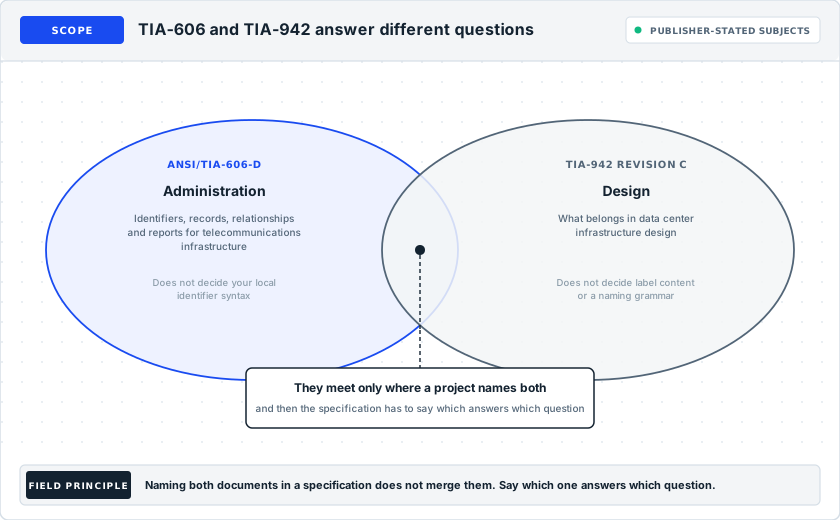
The two are quoted together often enough that "make it TIA-942 compliant" arrives as a labeling instruction. It is not one. TIA's official overview lists TIA-942 at Revision C, published May 2024, and describes a data center and computer-room infrastructure scope. TIA-942 overview.
| Comparison | Administration standard | Data center infrastructure standard |
|---|---|---|
| Publisher's stated subject | Administration of telecommunications infrastructure within and between buildings | Data center and computer-room infrastructure |
| Edition shown on the publisher page | D, October 2021, with E at ballot | Revision C, May 2024 |
| Question it helps you answer | How identifiers, records, relationships, and reports are organized | What the facility's infrastructure is expected to include |
| What it does not hand you | Your local identifier syntax | Label content or a naming grammar |
When a specification names the facility standard inside a labeling scope, ask which requirement was intended. Usually the writer means one of three things: that the room should be built to a recognized design, that identifiers should be administered consistently, or that the handover documentation should be complete. Those route to different documents and different owners, and answering the wrong one produces a labeled room with no usable records.
Start with the decision the label supports#
A data center contains several kinds of identification. A cable ID links two terminations to a connection record. A rack ID locates a cabinet. A safety message communicates information assigned by the relevant safety program or equipment documentation. A pipe marker describes a service and its direction according to the applicable design. These messages can appear next to each other without sharing the same owner, approval process, or source.
Begin a project with a map of those decisions. For each object class, record the intended reader, the question being answered, and the document that governs the answer. This makes a request such as 'use the standard labels everywhere' concrete enough to review. It also helps a contractor discover missing instructions before hundreds of labels have been produced.
Put each source in the right role#
The TIA FOTC overview describes TIA-606-D as an administration standard for telecommunications infrastructure, including identifiers, records, relationships, and reports. TIA's separate TIA-942 overview covers a broader range of data center infrastructure. Use those scopes to route a question to the right document, then consult the actual project edition for a requirement. Neither overview is evidence that a chosen identifier string or complete facility has been certified. TIA-606-D scope, TIA-942 scope.
| Question to resolve | Source to obtain | Decision to record |
|---|---|---|
| What does the identifier mean? | Adopted administration requirements and local dictionary | Object type, scope, grammar, owner, aliases |
| Where can this label fit? | Equipment instructions, physical layout, approved placement | Viewpoint, available space, readable content, restrictions |
| What belongs on a safety marking? | Applicable safety requirements, approved analysis, equipment documentation | Responsible reviewer and controlled label source |
| Will the material suit this application? | Material data, print compatibility, relevant recognition conditions | Exact construction, surface, exposure, evidence and gaps |
| Which field controls the printed value? | Approved record and interface specification | Field owner, transformations, rejection handling |
| What proves completion? | Project acceptance criteria | Population, inspection method, evidence and exceptions |
Treat the table as a routing tool. It does not supply the missing technical approval. Its purpose is to prevent a label designer from resolving an electrical, mechanical, or data-ownership question through a convenient formatting choice.
Record edition, applicability, and access separately#
A useful source register has three distinct entries: the document and edition, the reason it applies to this project, and the evidence the reviewer actually consulted. A search result or publisher abstract may establish the document's subject. A purchased or otherwise authorized copy may be needed to evaluate its full requirements. A local specification may state which edition was adopted for an existing installation.
Do not overwrite an existing policy's edition field merely because a newer document appears in a search. Open a review that identifies the changed requirement, affected population, responsible owner, and disposition. Similarly, a ballot or public-review notice signals development activity; it is not itself the published replacement text. Keep the publication status visible in the source note and distinguish it from the project's adoption decision.
This matters in a multi-site rollout. Two facilities may have different governing project documents even when their printed rack IDs share a common grammar. The central dictionary can own namespace uniqueness while a site-specific appendix records local requirements and approved placement details. A shared brand of label printer does not resolve those differences.
Translate a requirement into observable acceptance#
Write the acceptance statement with an object population, a criterion, an inspection method, and an evidence reference. For example, a fictional project might require that all cable records in work package WP-004 have a unique cable key, two complete endpoint references, and two readable installed tags that agree with the released schedule. The project team then specifies how each relationship is established and who reviews an exception.
That is more useful than a checkbox named 'TIA compliant.' The detailed statement reveals whether the review covered content, physical readability, record consistency, or all three. It also prevents a photograph of one attractive label from being treated as evidence for an entire room.
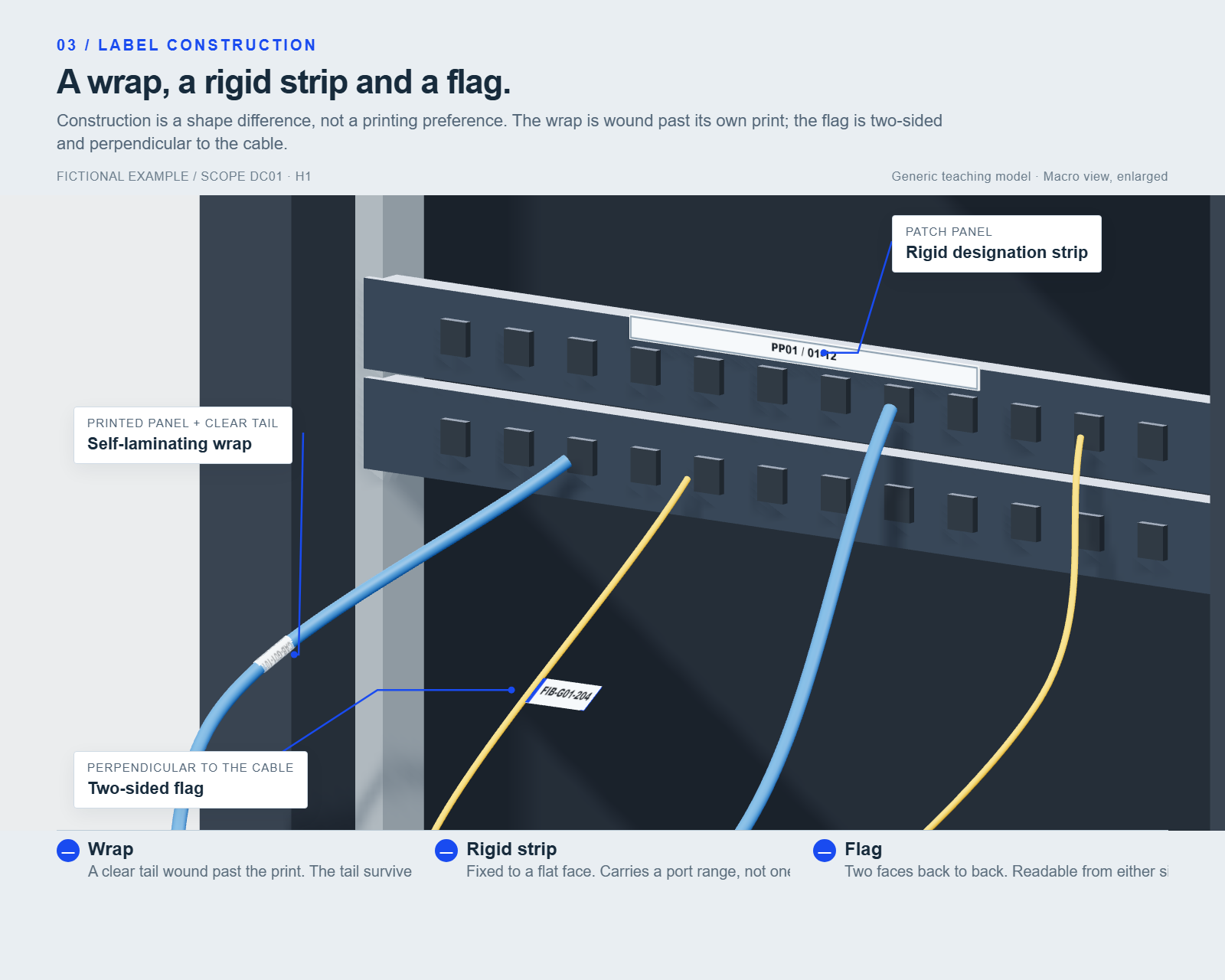
Avoid adding dimensions or offsets because they appeared in a vendor illustration. Record a placement distance as a local design choice or manufacturer instruction when that is its actual basis. Before calling it a standard requirement, confirm the applicable text, its context, and any conditions. Port spacing, available label windows, wrap construction, and surface geometry still need a product-specific check.
Interpret material recognition without expanding its scope#
UL's marking and labeling program distinguishes evaluated label constructions and publishes conditions of acceptability, including relevant surfaces, temperatures, and exposure conditions. It also distinguishes categories for printing materials and for flag, tag, and wrap-around products. A general 'UL label' description leaves important application details unanswered. UL program overview.
Ask the supplier for the exact product, evaluation category, applicable conditions, and compatible printing system. Match that evidence to the proposed application. Keep any unresolved difference visible: a different surface, printing consumable, exposure, or intended use may need further review. Do not convert recognition of a particular construction into a claim that every printer output or entire labeling project is approved.
The procurement record should retain the evidence identifier and the decision made from it. A field sample can help assess placement and handling for the proposed use, but a short local trial does not establish an untested service life or expand a certification's scope. Keep the trial result and the supplier's claims in separate fields so later reviewers know what each supports.
Worked case: one specification contains three different questions#
A fictional project at DC01 asks for 'standard-compliant labels' on cabinets, power equipment, and cooling pipes. The print team receives one spreadsheet with ID, description, and color. It could create visually consistent output, but the file does not establish who approved each message.
The project owner splits the review by label function. Cabinet IDs are checked against the approved namespace and room drawing. The electrical owner supplies the controlled references for equipment and safety markings. Facilities supplies the approved service names and pipe-marker requirements. Each owner then identifies the relevant material and placement evidence for their objects.
The print spreadsheet still has a shared layout where appropriate, but each row now carries a label class, governing reference, revision, and reviewer. Rows without those inputs remain outside the released batch. After the physical proof is accepted, the installer records which approved output was applied to which object. The handoff package explains the basis of the work rather than relying on the appearance of consistency.
Manage disagreements without erasing evidence#
When two sources differ, capture the exact issue before choosing a winner. A manufacturer's installation restriction, an adopted project requirement, and an older local drawing may each address a different aspect of the application. Name the conflict, identify the affected objects, and route it to the person authorized to resolve that aspect of the design.
Record the resolution with its scope and revision. A decision for one cabinet model should not silently become a rule for every cabinet. If work proceeds under an approved exception, preserve the exception's conditions and next review trigger. If the issue remains unresolved, keep it visible in both the work package and the affected record so a later export cannot disguise it as a completed decision.
Acceptance checklist#
Frequently asked questions#
Can one standard cover all data center labels?#
Build the source map by function. Identifier administration, equipment instructions, hazard communication, material qualification, and project acceptance answer different questions. A single brand or visual template does not eliminate those distinctions.
Is a publisher webpage enough to verify a clause?#
A scope overview can support a statement about the document's subject. For a precise requirement, consult the appropriate authorized text and its project context. Record what was available rather than implying a full-text review occurred.
Should we rename everything when an edition changes?#
Open a controlled applicability review. Identify the actual changes and affected objects before deciding whether the installed scheme needs revision. Retain historical mappings when identifiers change.
Does a successful print proof establish compliance?#
It establishes the specific observations made during that proof, such as content, fit, or readability. It does not by itself establish all project requirements, electrical safety, or a material's lifetime.
What should a contractor submit before labeling starts?#
Request the identifier dictionary, source and edition register, proposed materials and placements, record schema, physical proofs, and exception process. Agree how the receiving team will inspect those deliverables before approving a full production run.
Is TIA-606 mandatory for a data center?#
Not by itself. A standard becomes binding on your work through a contract, a specification, or a regulation that adopts it, and that adoption decision is made by your project rather than by the publisher. Separately, some markings on the same floor are required through electrical installation codes and workplace regulation that apply whether or not any cabling administration standard was named. Establish which route applies to each label class before describing anything as mandatory.
Which class of administration does a data center need?#
The class model keys on the size and complexity of the cabling plant, from a single equipment room at Class 1 to a multi-campus or multi-site system at Class 4. In practice the decision you are really making is how wide the uniqueness boundary for an identifier has to be. An operator with a second site needs that boundary settled before numbering begins, not after both halls have a cabinet called R101. Confirm the class obligations against the edition your project adopted.
Is TIA-606-B still current?#
No. The publisher overview cited on this page names ANSI/TIA-606-D, published in October 2021, as the current published edition, and TIA issued a recirculation ballot and public review notification for TIA-606-E on June 19, 2026. A page or product description that presents B as the standard is describing a superseded edition.
That does not make an installation built to B wrong. What an installation was built to is set by the edition the project adopted, which is a separate field from the edition currently published. Before treating a B reference as an error, read the specification and find the edition it names. If the specification itself names B and the work is current, the question to open is an applicability review, not a relabeling project.
What is the current edition of TIA-606?#
The publisher overview cited on this page describes ANSI/TIA-606-D, published in October 2021, and TIA issued a recirculation ballot and public review notification for TIA-606-E on June 19, 2026. A ballot notice records a development stage, not a published replacement. Keep the published edition, the edition your project adopted, and the edition your reviewer actually read as three separate fields, because they are frequently different.
Does TIA-606 cover IT asset tags?#
An IT asset tag on a server or switch is not among the administration elements the standard lists. Its rule comes from your local asset policy and intake procedure, which is why an asset identifier travels with the device and carries no rack or position in the string.
The accident-prevention sign and tag rule at 29 CFR 1910.145 does not settle it either: that rule addresses signs and tags used to warn of hazards, and whether an operational asset tag falls inside its scope at all is the open question. Treat the asset tag as locally governed, and record who issues the next value.
Does TIA-606 tell me what to print on a label?#
It describes how an administration system is organized, in terms of identifiers, records, the relationships between records, reports, and graphical and symbolic requirements. Your identifier syntax, field meanings, permitted characters, and issuance owner remain a local policy that someone at your site has to approve. That is why a labeling project still needs a naming dictionary even when a standard has been adopted in full.
Which standard covers chilled-water pipe labels?#
Identification of aboveground pipes by the fluid they carry is the subject of ASME A13.1, not of the telecommunications administration standard. A chilled-water supply or return marker is outside TIA-606's listed administration elements, and its rule comes from piping identification together with the approved mechanical design.
Two limits are worth stating. The publisher overview establishes the document's subject; it does not supply the color, size or placement requirements, which are in the document itself, so this page does not reproduce them. And that overview excludes electrical conduits from its scope. An arc flash or hazard label on adjacent electrical equipment is a different document again, with its own owner.
Is TIA-942 a labeling standard?#
The publisher describes it as covering data center and computer-room infrastructure, at Revision C published in May 2024. Reading it as a source of label content produces a specification nobody can act on. When a labeling scope names it, ask whether the writer meant a recognized facility design, consistent identifier administration, or complete handover documentation, because those three intentions route to different documents and different owners.
Which document covers automated infrastructure management data?#
ISO/IEC 18598:2016 is the publisher record for the automated infrastructure management requirements and data-exchange standard, and its scope is the only thing cited here. What an installed system can actually detect depends on the hardware deployed and how it is integrated, not on the standard alone. Decide who converts a detected event into a trusted record before treating any automated observation as evidence.
How many standards should a labeling specification name?#
As many as it has owners for, and no more. Every document named in a specification creates an obligation to say which edition applies, why it applies, and who reviews conflicts against it. A specification naming six standards with one approver and no edition fields is weaker than one naming two with both fully recorded, because the second can be reviewed and the first cannot.
Put the decision into a record
EDITABLE PLANNING DOCUMENT
Site labeling standard template
Define scope, identifiers, records, material acceptance, and change ownership in one editable policy.
EDITABLE PLANNING DOCUMENT
Labeling scope and handoff specification
Set reviewable requirements for naming, material proofs, records, exceptions, and acceptance before installation.
Sources and applicability
- TIA FOTC: TIA-606-D scope ↗
Publisher-affiliated scope overview; does not replace the adopted full standard.
Read scope and linked guides - TIA: TIA-942 overview ↗
Publisher identifies the data-center infrastructure scope and revision C publication information.
Read scope and linked guides - UL: Marking and Labeling Systems Program ↗
Recognition categories and conditions of acceptability depend on the evaluated construction and end-use conditions.
Read scope and linked guides - TIA-606-E recirculation ballot notice ↗
TIA's June 19, 2026 recirculation-ballot and public-review notice for TIA-606-E. It establishes the notice's stage and date, not final publication or project adoption.
Read scope and linked guides - TIA: ANSI/TIA-607-E publication announcement ↗
Cited to place bonding and grounding identification with its own publisher. Establishes publication on May 17, 2024, not project adoption or clause detail.
Read scope and linked guides - NFPA: NFPA 70, National Electrical Code ↗
Cited as the publisher identity of the installation code carrying field marking requirements. Adoption, edition, and local amendments vary by jurisdiction.
Read scope and linked guides - NFPA: NFPA 70E standard development and editions ↗
Cited to distinguish electrical safety marking from identifier administration. No clause wording or label value is reproduced.
Read scope and linked guides - OSHA: 29 CFR 1910.303 ↗
Cited for the existence of US workplace electrical marking provisions, which carry their own applicability limits and exceptions.
Read scope and linked guides - OSHA: 29 CFR 1910.145 ↗
Cited to separate accident-prevention signs and tags from operational asset identifiers, which have a different function.
Read scope and linked guides - ASME: A13.1 piping identification ↗
Public scope overview only. It describes identification of fluids in aboveground piping and excludes electrical conduits; full color, size and placement requirements need the adopted text.
Read scope and linked guides - UL Solutions: UL 969A certification scope ↗
Cited for the bounded scope of flag labels, flag tags, wrap-around labels and related products. It does not place every data center cable marker under that standard.
Read scope and linked guides - ISO/IEC 18598:2016 publisher record ↗
Publisher scope record for the AIM requirements and data-exchange standard. Scope only; no conformance judgment or interface capability is inferred.
Read scope and linked guides - NIST: SP 800-53 official control catalog, PE-10 ↗
Cited as an example of the control sets an assessor works from. Whether a control is satisfied remains the control owner’s decision.
Read scope and linked guides