
Use it with the field guides
Look beyond the supply label to energy that remains in the equipment. The examples cover spring mechanisms, a loading-area hydraulic lift, and capacitor modules; each requires controls suited to its own hazard.
Educational examples for safety professionals. Actual work requires trained personnel, the employer’s equipment-specific energy-control procedures, and the manufacturer’s instructions. Watching does not confer authorization or electrical qualification.
Chapters
Jump to a transcript section; its time link opens that moment on YouTube.
- 0:00 Disconnected is not the final condition
- 0:48 Spring force waits for a release path
- 1:33 A restraint controls motion without erasing energy
- 2:16 Hydraulic pressure can remain after the pump stops
- 2:57 Verify the section that will be opened
- 3:38 Capacitors can retain electrical charge
- 4:29 Separate capacitor discharge from battery isolation
- 5:14 Residual motion and heat belong on the same review
- 5:57 A practical stored-energy review
Full transcript
Read or save the Markdown transcript. Published October 2, 2026. Original 3D animation, AI-assisted scripting, and synthetic English narration.
Disconnected is not the final condition
0:00 on YouTube ↗A supply has been disconnected and its isolating device is locked. What can still move, discharge, fall, or pressurize? That is the stored-energy question. It is especially useful in a data center because the work extends from electronic power systems to cooling machinery and material-handling equipment. In this episode, three cutaways show different mechanisms: a spring, a hydraulic lift, and a capacitor module. These illustrations explain why controls are needed. They do not specify a universal release method. The actual equipment procedure and manufacturer instructions determine whether energy must be relieved, disconnected, restrained, or otherwise rendered safe for the task.
Spring force waits for a release path
0:48 on YouTube ↗A compressed or tensioned spring can store mechanical energy without any motor running. Think of a spring-return actuator on an appropriate cooling-system valve or damper, or a spring-loaded mechanism within electrical switchgear. The particular design determines the hazard. In our cutaway, a linkage holds the spring in its compressed state. Removing the wrong part could release the force into that linkage and the person working beside it. The safe approach is established in the manufacturer procedure: controlled release or an appropriate engineered restraint, as applicable. Never improvise a restraint or place a body part in the possible travel path while trying to prove it will hold.
A restraint controls motion without erasing energy
1:33 on YouTube ↗Notice what changes when the approved restraint is in place. The mechanism's travel is controlled, but the spring may still contain energy. This is why saying every job reaches zero energy can be misleading. Some procedures make a hazardous condition safe by restraining it rather than eliminating every form of energy. The restraint must be suitable for the load, correctly positioned, and verified as the procedure requires. Our yellow indicator marks the restraint in the illustration; the color is a teaching convention, not a safety rating. The work boundary must keep people clear of energy that remains stored outside the protected task.
Hydraulic pressure can remain after the pump stops
2:16 on YouTube ↗Hydraulic systems convert fluid pressure into force. A lift in a data center receiving area is a useful example. Stopping or isolating its pump does not necessarily remove pressure trapped by valves, nor does it remove the gravitational energy of the raised platform. A cylinder or hose may still be supporting a load. Loosening a connection to see whether pressure remains can itself create a dangerous release. The equipment procedure must specify how the load is brought to a safe position or supported with approved mechanical means, how pressure is controlled, and how the relevant condition is verified before servicing.
Verify the section that will be opened
2:57 on YouTube ↗The location of a pressure indication matters. A gauge on one side of an isolating valve may not describe a trapped section on the other side. A failed gauge also does not become reliable because its needle points to zero. Follow the designated verification method for the actual section being serviced. If pressure can return through leakage, connected equipment, or another mechanism, the procedure must maintain protection and continue verification as needed. For safety review, ask the team to identify the exact volume that will be opened and explain what prevents it from becoming hazardous again during the work.
Capacitors can retain electrical charge
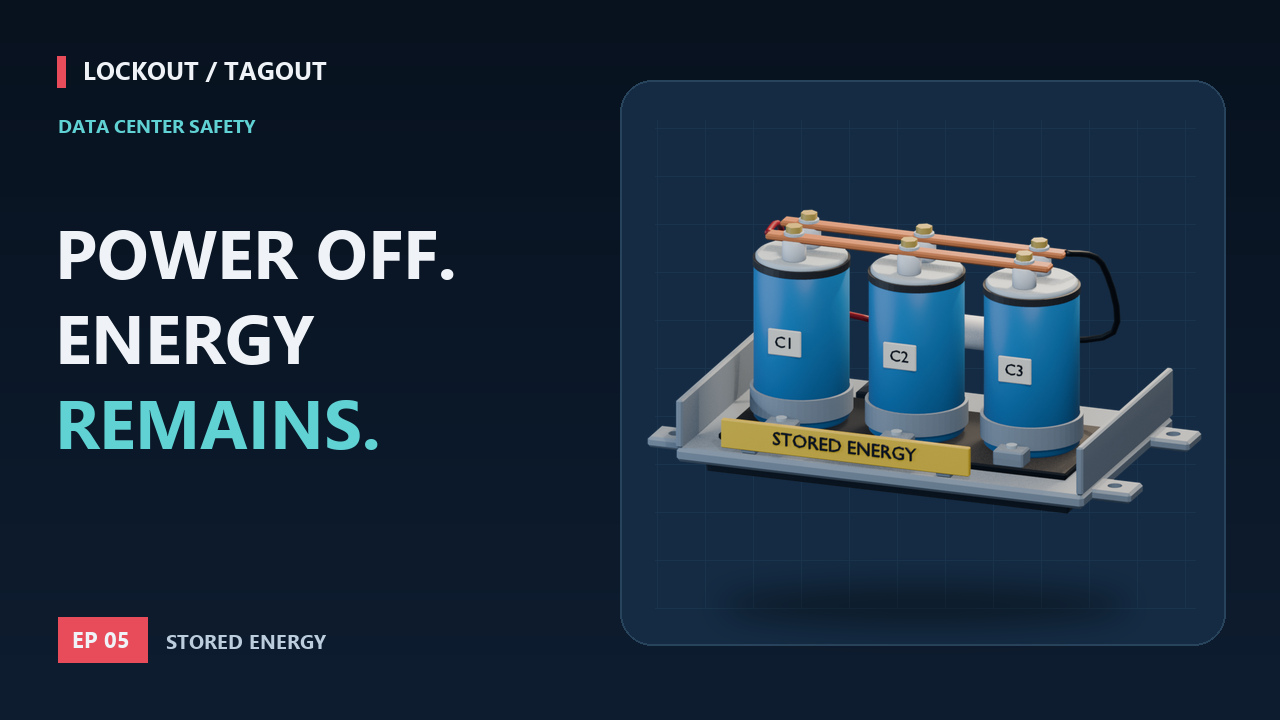
3:38 on YouTube ↗A capacitor stores electrical energy. UPS equipment, variable-frequency drives, and other electronic power systems can contain capacitors that remain hazardous after external sources are disconnected. Manufacturer instructions may specify discharge times and additional actions, but there is no universal countdown for every device. Our animated charge graphic is symbolic; its disappearance is not a substitute for a measurement. Electrical work on the equipment requires the appropriate qualified personnel, safe work practices, and verification. Do not improvise a discharge by bridging terminals with a tool. The correct method is equipment-specific, and components handled during the process may still need to be treated as energized.
Separate capacitor discharge from battery isolation
4:29 on YouTube ↗Inside a UPS system, capacitor discharge and battery isolation are related but different tasks. Disconnecting the normal AC input may leave the battery supplying parts of the system. Isolating the battery connection may still leave charged capacitors. And the disconnected battery itself still stores chemical energy capable of producing electrical output. The procedure must match the component being serviced, including any bypass or auxiliary supplies. A single cabinet-wide claim that the energy is gone can hide these distinctions. In the animation, the battery and capacitor are labeled separately so viewers can trace which control acts on which hazard.
Residual motion and heat belong on the same review
5:14 on YouTube ↗Springs, hydraulics, and capacitors are not the whole list. A fan rotor can coast. Another airflow path may drive it. A hot component can remain hot after shutdown. A suspended part can move when its support is removed. The shared logic is to identify the remaining energy, determine how it could be released, apply the appropriate control, and verify that the task is protected. Do not turn a successful electrical test into a conclusion about pressure, temperature, motion, or gravity. Each relevant energy form needs evidence appropriate to that form and to the actual work being performed.
A practical stored-energy review
5:57 on YouTube ↗Use the cutaways as questions for a pre-job briefing. What still contains energy after isolation? Which action during servicing could release it? Which approved method controls it? What observation or test confirms that method has worked? Finally, could energy reaccumulate while the job continues? A complete answer may involve several disciplines and several verification methods. If nobody can explain a possible source, keep the job paused until the uncertainty is resolved. The final episode now combines this reasoning with the hardware and group-control principles in one animated cooling-fan maintenance scenario, from planning through deliberate return to service.
Episode reference links
These are the primary references used in the episode. Manufacturer documents apply to the equipment they describe; the animation is conceptual. Check the actual installation, applicable requirements, and current equipment instructions before planning work.
- OSHA eTool - Specific procedures and control-circuitry prohibition ↗
- OSHA 29 CFR 1910.147 - The control of hazardous energy ↗
- Stored energy toolbox talk hosted by OSHA (grant-developed educational material) ↗
- OSHA eTool - Required content of energy-control procedures ↗
- OSHA hydraulic-system lockout interpretation, November 10, 1999 ↗
- Eaton 93E UPS installation and operation manual - maintenance safety ↗
- OSHA 29 CFR 1910.333 - Selection and use of work practices ↗
- Schneider Electric - How does a UPS system work? ↗
- OSHA Lockout-Tagout eTool - Definitions ↗